

07/25/12 10:29am

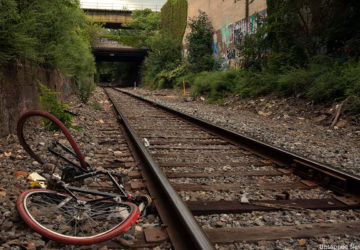
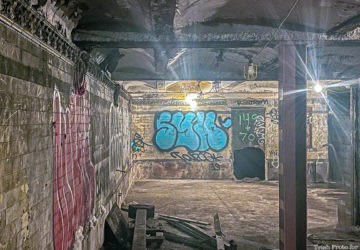
What may become the Queens High Line, the city’s next elevated, 3.5-mile long pedestrian and bike path, is still very much just another ghost of the New York’s past. Yet a short walk down a portion of it in its current, rawest state reveals that it can be just as enchanting as even the city’s most delicately planned parks. The surroundings of what is now named “Queensway” are at once history, nature, vandalism, and working class single-family homes. Told you New York had it all.

The tracks of the former Rockaway Beach branch of the LIRR (or, less formally, the White Pot Junction line) tear down the center of Queens””starting at Rego Park going toward Howard Beach””and then hang east on trestles toward the Rockaways. It was possible, then, for some residents of Queens to get to Penn Station in half an hour, give or take. As nice (an currently unimaginable) as it was, the point was not convenience to Midtown Manhattan, but the beach, another half hour going the other direction. In a recent Queens Gazette column, Gregory Bresiger breaks down what was apparently quite a scenic route:

By 1881, it linked up with the LIRR’s Atlantic Avenue branch at Woodhaven. Those going on to the Rockaways transferred at Ozone Park. Just a half mile or so beyond Ozone Park, the service continued to Rockaway Park or on to the LIRR’s other branch on the peninsula, which terminated at Far Rockaway.

Until the line fell to infrastructural and financial burden about fifty years ago, the independently operated line carried passengers from central and southern Queens to and from Ozone Park. Part of the line was absorbed as part of the A train in 1956 and is now the southern terminus of the potential QueensWay. (Apparently, the Ozone Park stop can still be seen from Lefferts Boulevard just past the 102nd  Street stop.) Another section lives on as a part of the LIRR’s Rockaway Beach branch, originally going from Glendale to Rockaway Park.

The tracks, mostly quite visible, never quite left the radar of those who either grew up or around them, or in homes that were constructed right next to them after the line was abandoned. And now this Queens High Line is slated to be  one of innumerable projects around the world  whose hopes of turning old infrastructure into functional, well-designed public space had been realized thanks in part to the completion of the High Line. The Trust for Public Land has announced a partnership with Friends of the QueensWay and the City of New York””who now own the trestles and land underneath the””to produce a feasibility study, cost estimates, and programming to solicit community input. Until then, this abandoned Queens High Line, a New York City asset, can still be viewed in its most exciting state””one that reflects the city’s unrelenting eye for unbridled, trash-into-treasure potential. If you haven’t seen the third section of the High Line in its raw state, check it out before it’s turned into a park.  

07/20/12 10:47am

After traveling through the 4,5, and 6 lines  last week, I’ve hopped on over to the N,Q, and R subway lines to journey primarily through lower Manhattan and Brooklyn.

R Line

Jay Street-MetroTech

With a wide spectrum of vibrant colors, the mosaic on the South Mezzaine wall of this station is quite the eye-catcher. It spans the length of the corridor, breaking up the otherwise monotonous white and barren walls. Arranged in symmetrical patterns, Ben Snead’s mosaic, Departures and Arrivals, underlines the relationships among different species and their roles in Brooklyn’s ecosystem.

Q Line

West 8th Street-NY Aquarium

When architecture and art intersect, that’s when you get Wavewall. Designed by architect Jim Connel and artist Vino Acconci, this station’s walls and stairway takes its form from the nearby Cyclone roller-coaster. Since West 8th Street is an elevated station, it possesses the capacity to manipulate its outer shell unlike the underground station and appropriately does it here. Walking up the stairs towards the Manhattan-bound trains, the interior space resembles a frozen point in time while in the midst of a high-speed thrill ride.

N + R Lines

23rd Street

Struck by boredom but have at least one friend with you along with a camera or camera phone? Then you are in luck because at this station, an impromptu photo shoot can easily come about. With its carnival-esque public art, commuters at this station can directly interact with Keith Godard’s Memories of Twenty-Third Street by posing underneath the images of hats. Alongside these mosaics are tiles that cite the famous owner of each hat such as Oscar Wilde or Eleanor Roosevelt.

Found on both sides of the platform, you might catch a fellow commuter standing beneath an extravagant hat while you yourself unknowingly stand underneath an equally whimsical head piece.

Cortlandt Street

When she first began planning out the artwork for this station, Margie Hughto stated, “I thought about all the different peoples, products, objects, and money that passed through the area, and I visualized a treasure vault filled with coins, gems and artifacts — rich, golden, glowing, and somewhat mysterious.”

Eventually, she ended up creating Trade, Treasure and Travel, handmade ceramic relief tiles based on the themes of finance and trade. Located on each side of the platform and in the passageway between downtown and uptown-bound trains, these panels contain several glossy images that can be easily linked to its theme, such as the dollar theme and finance. However, Hughto makes some rather obscure references. For instance, some panels include mythical figures, such as griffin, that are still connected to the theme of trade.

Get in touch with the author  @iyisak

07/16/12 1:37pm

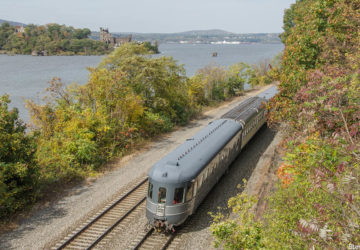
A train on the French RER line has been decorated to high style following a partnership between the rail company and the Château  of Versailles.

The subway train which operates a service from Paris to the Château  has been given a palatial face lift to put travellers in the right frame of mind before their visit to the magnificent UNESCO site.

Seven carriages on the train have been completely redecorated with images of the Hall of Mirrors, the Temple of Love, Louis XVI’s library, the Gallery of Battles (image above), the Queens Chambers at the Petit Trianon, the coach of the Coronation of Charles X and the English style garden of the Petit Trianon.

From now until the end of August hostesses from the Tourist Office of Versailles  and SNCF agents will travel on trains to educate tourists on the Palace of Versailles or the different attractions to discover in Paris. 50,000 people per day travel on the RER C line which this train operates on, and whether its being used by those travelling to work or tourists, the look of the train is bound to improve traveller’s moods and encourage them to visit the Versailles Palace.

Rail company SNCF have plans for five more trains to be decorated in the same film decoration technique by the end of 2012 — talk about arriving in style!

This article was originally published on The Good Life France,  an Untapped Cities partner site.  

07/12/12 11:49am

After last week’s ride through the 1,2, and 3 lines, I have now transferred over to the 4,5, and 6 subway lines to explore another side of New York’s subway art.

Line 4

Crown Heights-Utica Avenue

Simple, clever, and playful, Hugo Consuegra’s Good Morning and Good Night focuses on the temporal quirks of its subway location. For commuters heading towards Manhattan in the morning, Good Morning decorates the inbound side of the station with various scenes featuring the Sun. As for riders returning to Brooklyn at the end of the day, when they disembark from the train Good Night with its scenes of the moon receives weary travelers.

Good Morning on the inbound side of the station

Good Night on the outbound side of the station


Line 5

Brooklyn College-Flatbush Ave

Intermingled with movie posters along the wall, there is an odd juxtaposition of showy advertisements and artwork that looks like it has been excavated, a relic from a bygone era. Muriel Castanis’s bronze reliefs, Flatbush Floogies, appeared at this station 16 years ago. The empty space between the sprites or nymphs, shrouded in the classical Greek form of wet drapery, recalls urban legends associated with the neighborhood in addition to folklore from the original residents, the native Canarsie tribe.

Haunting and slightly spooky, I thought that this series of reliefs took an original approach to illustrating the history of the neighborhood.

Line 6

77th Street

Flowers easily fall prey to banal symbolism, but Robert Kushner’s 4 Seasons Seasoned is a flower mosaic that simply represents flowers.

To be more precise, Kushner’s flowers reflect the abundance of flower shops on the Upper East Side. With a touch of delicate Japanese linear forms, this bright and cheery mosaic makes itself known to commuters who walk underneath it when entering the station.

Lines 4 + 5 + 6

Brooklyn Bridge-City Hall/Chamber Street

Decorative yet functional, graceful but durable, Mark Gibian’s Cable Crossing extends the motif of the nearby Brooklyn Bridge. According to the artist, his steel works “echo the beauty of the bridge’s cross-hatched cables and the feeling of flight as it springs across the East River.” With its crisscross networking of cables, Gibian’s artwork certainly evokes a sense of dynamic movement via the power of modern transportation.

Get in touch with the author @iyisak

07/03/12 9:05am

A subway station is home to two extremes: the harried commuter whose mind is split between the time and not spilling his coffee while doing that awkward combination of walking and jogging, and the stationary traveler who waits for the approaching train. However, armed with an iPhone and camera, my mission was not to frantically arrive at a destination on time but to examine fixed artifacts at several stations: the subway art.

This exploration into the underground was made possible by the app, Arts for Transit, which Untapped introduced in a past article. However, this article and following ones will go over artworks that I find to be notable, whether because of their initial obscurity, interactivity with commuters, locality, or just general delightfulness.

Line 1

116th Street-Columbia University

Brief and straightforward, the title of Michelle Greene’s installation, Railrider’s Throne, is just what it implies. When I entered this station, one gentleman had already claimed ownership to the seat. Calmly reading his newspaper on this kingly chair, he certainly fit the image of royalty. According to Greene, “I wanted to create a whimsical environment that allows the commuter to feel special as opposed to alienated.” Well, with the functionality of a comfortable resting place among travelers along with its abstracted regal design, this work has constant interaction with the station’s temporary inhabitants.

Houston Street

Out of the many mosaics that adorn the MTA subway, Deborah Brown’s Platform Diving adds quite a playful nature to this station. With beluga whales, turtles, and manatees making their underwater commute, Brown mischievously places these itinerant animals right behind their human counterparts.

Line 2

Jackson Avenue

George Crespo’s Latin American Stories is a highly contextual series of stained glass windows at this Bronx subway station, located in the only borough with a majority of Hispanic residents. Six narratives span both sides of the platform, each illustrating a different regional fairytale from Latin America.

While aware of the local demographics, Crespo is also conscientious of the station’s elevated status. With a natural abundance of light, his choice to use stained glass windows strengthens the effects of the images with soft manipulations of light.

Crespo’s awareness of location, whether it be the current physical setting or the past homes of the neighborhood’s residents, works to create mementos that pay homage to the heritage of Latin American immigrants.

Atlantic Avenue-Pacific Street

Despite the detailed directions given by the app, I spent several minutes hunting for George Trakas’s Hook (Archean Reach), Line (Sea House), and Sinker (Mined Swell), that is, until I realized that I hadn’t properly looked above me.

Working in conjunction with the architects, the surrounding space and installation of this particular passageway were meant to harmonize with each other. Trakas’s work, a steel sketch of a sailboat, echoes the material that accentuates the structure’s interior. With the architects’ installation of a skylight and the vast space below the artwork, Trakas’s “boat” seems to float of its own accord, above a sea of commuters.

Line 3

116th Street

Another one of my top mosaics includes Vincent Smith’s Minton’s Playhouse (uptown), The Movers and Shakers (downtown). Like George Crespo’s stained glass windows in the Bronx, Smith’s artwork is a tribute to the neighborhood where the station is located. In this case, this series of mosaics pay homage to the past notable residents of Harlem.

In addition to vivid glass pieces, the slanted and curved lines of the mosaic pieces enhance the sense of movement and liveliness of a past era.

Times Square Station Complex

While technically not in the subway, the MTA app includes Max Neuhaus’s sound installation. Unnamed and unmarked, I wouldn’t have noticed this artwork if I wasn’t deliberately roaming around the pedestrian area on 46th Street. With the cacophony that is Times Square, it was difficult at first to discern any distinct sound from below. However, perhaps earlier or later in the day (definitely not during rush hour when I was there) maybe you can hear the deep, organ-esque sounds that flows upward from the grating.

Bonus!

There is one work of art at the Times Square hub which is not on the app. The artwork in question, The Commuter’s Lament or A Close Shave by Norman B. Colp, can be found in the passageway from the 8th Ave./42nd St. station to the Times Square station. Situated on the overhead beams, Colp cleverly placed his installation there for the despondent and weary commuter. Untapped previously covered this in our series about Sequence Art in NYC.

Get in touch with the author @iyisak

06/25/12 10:07am

As New York City adapts to climate change and embraces alternative energy, many structures and spaces too must adapt to meet new demands and avoid becoming obsolete. The High Line is a shining example of how unplanned obsolescence can inspire imaginative and practical use of a discarded structure.

281 West 96th  Street from Christopher Payne’s book,  New York’s Forgotten Substations: The Power Behind the Subway (2002).  The property is currently vacant.  

A less celebrated story of urban resilience is found in the former power substations of the MTA. From 1881 to 1999, subway trains were powered via a series of electricity hubs scattered throughout the city. The large, manually operated machines that transferred power from plants to subway lines were housed in “substations.” These structures are truly an example of purpose driven design- the layout of each was dictated by the machines inside. Much like early 20th  century factories, the stations constructed at this time featured large windows across the front and roof to maximize daylight exposure.   These requirements gave each of the stations a very distinct look and footprint; once you know what to look for, you will begin to see these buildings throughout Manhattan, Queens, Brooklyn and the Bronx.

In 1997, photographer Christopher Payne walked by Substation 21 in on his way to his Brooklyn Heights home. Though he passed by the building on Willow Street on a regular basis, he felt compelled to peer through the open front gates on that particular day. To his surprise, he saw a crew of men working on a slew of antiqued machines. Payne describes the scene as something that belonged in at the turn of the 20th rather than 21st century, and made him wonder “how is it that something so industrial exists in the middle of a typical city block, next to an apartment or a glass office building?”  The experience piqued his interest as an industrial photographer who documents industrial ruins and vanishing building typologies. As Payne stumbled across Substation 21 right as the MTA was converting the subway power system, he was able to document the substations during their transition into obsolescence. His book, New York’s Forgotten Substations: The Power Behind the Subway  (2002), beautifully documents the structures both through photographs and in narrative.

Given his love of the industrial, Payne described the process of watching the substations being “completely gutted” as painful: “they were tearing apart something that should have been in a museum. Not to be overly sentimental, but every time I saw one being demolished, I felt like I was losing a friend.” While the machinery was removed in each station, the structures were left standing, As space is scarce in NYC, many of the buildings have been renovated to become residential, retail and even industrial buildings. However, a leopard cannot change its spots. Despite being repurposed, the substations retain their signature aesthetic.

From top left corner:

155 East 60th Street: Bloomingdale’s HR Department

204 Elizabeth Street: Erica Tanov retail space

 175 Spring Street: Metropolitan Lumber

39 Jane Street: Condos

30 Horatio Street: Apartment complex

51 Park Place: Previously a Burlington Coat Factory, the property is now part of the contested 9/11 memorial mosque proposal

Payne attributes his knowledge of the stations to Robert Lobenstein, a retired New York City Transit General Superintendent and unofficial historian of the city’s subway system. Lobenstein and his friend Joseph Cunningham have painstakingly documented the evolution of these substations from 1881 to present day. In partnership with the New York City Transit Museum, Lobenstein leads “Substation Safaris,” or tours of stations throughout the city. The next tour on the docket is at the 46 Cliff Street Substation, near South Street Seaport on July 7th (click here to reserve tickets).