


02/11/13 9:36pm

For me, the ‘regular’ New Year has always been supremely disappointing. Due in part to globally inflated expectation, the night has never lived up to the description my co-workers provide in the annual ‘New Year’s Eve in East Williamsburg!’ email chain. If you’re new to the city, this means you’ll probably end up in some ‘charming’ warehouse off the Graham Avenue stop with 60 people you’ll never see again.

You’ll begin to take stock of the evening at 11pm, 30 minutes after half your friends go down (hard) for the count. Following a midnight ‘champagne toast’ that was supposed to be included in the $150 ticket fee, you’ll wander home, shocked that you fell for it. And then you’ll do it all again next year.

Chinese New Year, however, is different. Strip away the expensive parties and sharp wardrobes, add a few dozen homemade Chinese lion costumes and 400 million confetti launchers, and you’ll be getting close. Though I’ve had the opportunity to enjoy several Chinese New Year celebrations in New York City, I knew I had to go all out this year. And we’re just getting started.

Chinatown_NYC_ChineseNewYear_ChineseLionsLittle Chinese Lions Celebrate The New Year

We met at Jing Fong Restaurant on Elizabeth Street at 10:30am, 2 (or possibly 36) hours after we should have gotten there. The wait at Chinatown’s most lavish Dim Sum restaurant was, according to the hostesses, 1 hour. We would later discover that this was a perpetual waiting time, one that would never actually come. Jing Fong is always busy; on the New Year, it’s JFK hopped up on natural Chinese energy supplements.

Chinatown_NYC_ChineseNewYear_DimSumA Dim Sum Cart Makes The Rounds At Oriental Garden

Since we wanted to eat before the day was over, we walked next door to Oriental Garden. At 1/75 the size of Jing Fong, we were surprised that the wait was as short as it was. After eating through 16-20 amazing plates, we were shocked. Over the course of an hour, we sampled lotus leaf sticky rice, chive, seafood, taro, and pork dumplings, stuffed eggplant, baked roast pork buns, stuffed spicy peppers, and plenty of other Dim Sum selections. Everything (yes, everything) was wildly delicious, and we all walked out for less than $20.

Chinatown_NYC_ChineseNewYear_DumSumDishesA Few Of The Many Dim Sum Dishes At Oriental Garden

Our next destination was Mott street, just one block west, where a celebration was brewing. Chinese vendors battling to sell 2/$5 confetti launchers could be heard from Bowery to Broadway, and men in ornately detailed Chinese lion costumes traveled door to door to help local businesses usher in an auspicious new year. All the while, delighted children collected decorated envelops full of good luck coins and one dollar bills. The crescendo came with the arrival of a gigantic hand-made snake that wove through the crowd to mark the beginning of its year.

Chinatown_NYC_ChineseNewYear_SnakeThe Snake Celebrates Its Year

But it was among the brave, fallen confetti launchers on Mott Street where I found it – the greatest purchase I’ve ever made, and the greatest purchase I’ll still have made by time I reach my death bed, likely 150-200 years from now. I’m speaking, of course, of my own personal Chinese lion mask. See figure below for more information.

Chinatown_NYC_ChineseNewYear_LionMaskYes this is me. I wish you could see my smile. ($35)

Though I was not born into this culture, I’m endlessly grateful that I have been welcomed into it by Chinatown’s locals. With the mask on, I transformed entirely. I spent the rest of the afternoon quite literally parading around, mimicking more experienced lions, jumping in photos (by request or otherwise), and genuinely becoming part of a culture I have grown to respect so much.

Chinatown_NYC_ChineseNewYear_AugustinAndFireworksAugustin Fires Confetti Into The World

5 hours later, with a lifetime’s worth of confetti forever sewn into my clothing, I left the celebration and traveled back to Harlem. But the celebration didn’t leave me. Though New York’s biggest New Year celebration in Flushing is still 5 days away, Mott Street on Chinese New Year is a pretty close second, and I know I’ll be back every year for as long as I’m able. And I hope you will, too. Happy New Year!

Chinatown_NYC_ChineseNewYear_GroupShotGroup Shot! Some Amazing People I Met Sunday

Don’t forget to try out Oriental Garden!

Oriental Garden   [Map]

14 Elizabeth Street
New York, NY  10013
212.619.0085

Chinatown_NYC_ChineseNewYear_TwoLions

Read more of Luke Kingma’s Sunday in Chinatown column.  

01/20/13 9:09pm

Up until recently, I was wrong about some things. As far as Asian food was concerned, I always believed my world ended in Flushing. You could certainly travel east of there, but you’d find nothing but oceans – first, a traditionally liquid one; then, an ocean comprised entirely of European food. To my knowledge (or lack thereof), you’d have to travel as far as Kashgar before you found the next great Asian restaurant. But then we discovered  Mapo BBQ.

Mapo_BBQ_Queens_Exterior

You could take the 7 train as far as it goes without ever reaching Queens’ Murray Hill. Far beyond Flushing, past dozens of nondescript apartment complexes and a handful of residential dentists, lies this tiny neighborhood where our real journey begins. Looking more like a suburb of Pittsburgh than a borough town, Murray Hill is strikingly quiet and empty, even on a Sunday afternoon.

We took the rare LIRR ride to try what many call a legendary BBQ experience. Mapo, like most restaurants we love, is nothing special in terms of location, decor, or atmosphere. The beauty, of course, is found in what can be eaten. We huddled through a small doorway and were met by a single family enjoying lunch together. There were almost a dozen of them, and ten times as many plates spread across their tables. This was the place.

Mapo_BBQ_Queens_FamilyTried to be discrete. Was not discrete.

My favorite culinary experiences are exactly that – experiences. While most restaurants offer a standard, rushed itinerary, spots like Mapo treat you like family on Thanksgiving. It’s intimate and exhausting, and can easily turn into an all day affair if you’re not looking. Shortly after being seated, one server explained the menu while another prepared the charcoal. We knew we were here for ribs, and ribs we ordered: 2 orders of Kalbi Beef and 2 orders of BBQ Pork ended up being more than enough for five of us.

Mapo_BBQ_Queens_CharcoalThe charcoal is prepared.

While we waited for the meat to arrive and the charcoal to warm, our servers brought out the “Banchan,” an endless array of carefully prepared vegetables, sauces, and sides. From kimchi and barbecued onions to grilled corn and spicy tofu soup, the selections were as eclectic as you’ll find in New York. I’m not exaggerating when I recall that we may have had three to four hundred thousand plates on our table. It was heroically overwhelming.

Mapo_BBQ_Queens_GroupThe “Banchan.” This was just the beginning.

 After grilling our meat for us right in the center of the table, it was time to begin our long awaited experimentations. Using massive pieces of lettuce as our canvas, we got to work. At Mapo and other Korean BBQ places like it, there are endless combinations to try. On one piece, you might pile up Kalbi beef, kimchi, tofu, and the spicy house sauce; on another, you might try BBQ pork, cucumbers, jalapeños, onions, and crab. One thing’s for certain, though – whatever you try will be impossibly delicious.

Mapo_BBQ_Queens_ServerGetting intimate with our server.

The complexity of the flavor combinations found here is currently unmatched, at least in my own personal history. Everything is seasoned to perfection, and there is truly something for everyone. Two hours later, after having tried dozens of things for the first time, our journey was coming to an end. Leaving the restaurant felt very much like coming back from a spirit-awakening adventure halfway across the world. There was suddenly so much to say; so much energy; so many realizations about the world that you didn’t see clearly before. And all of it just 30 minutes from Penn Station.

Mapo_BBQ_Queens_MeatCU, meat.

It’s safe to say that this is the most inspired I have been to share in a long time. Though it’s certainly out of the way, and though it may take a whole lot of convincing to get a group out to Murray Hill, I implore you to try Mapo BBQ. It offers one of the few culinary experiences in the city that can take you far, far away from New York. You will likely spend $30-$35 a person here, but trust me – this is a meal you can’t get in Manhattan for two to three times the price. Go. Go now.

Mapo_BBQ_Queens_CreationOne of our many creations.

Mapo Korean BBQ   [Map]
41st Ave and 149th Place
Murray Hill, NY 11355
718.886.8292

Afterword:  Thanks to Connor for the recommendation!  

12/06/12 2:58pm

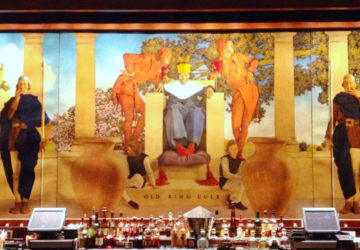
At Untapped New York, we’re dedicated to bringing you the best of New York’s cultural life and nightlife. Previously, we shared our picks for the best hidden bars  in the City. Now we’re bringing your our list of the Top 10 Bars where artists have left their mark, from Upper East Side institutions like Bemelmans Bar and the King Cole Bar in the St. Regis to the trendy Ace Hotel, with a collage by street artist Michael Anderson. Though a couple of cocktails at some of these bars might be a bit of a splurge, we think it’s worth it for the chance to soak up the atmosphere in these one-of-a-kind places. After all, you won’t find these works of art anywhere else in the world.

1. Bemelmans Bar

(more…)

12/05/12 9:01am

One of Renee Baumann’s Gingerbread Brownstones

Renee Baumann has gone to both architecture school and culinary school. For most of us, that would sound like two fields that would never actually collide, but Baumann has, interestingly enough, found a way to combine both of her passions: gingerbread brownstones! After gaining a lot of publicity for creating a Brooklyn brownstone out of gingerbread last year, the Brooklyn resident is repeating her culinary architectural experiments again this year””only this time, the stakes are higher. This year, rather than creating just a single home, Baumann is recreating an entire Brooklyn block with gingerbread””a lot of gingerbread.

Renee Baumann’s gingerbread brownstone, created last year. (Picture via Kitchen Table Scraps)

Renee Baumann’s vision for the gingerbread block she’s creating this year. (Picture via Kitchen Table Scraps)

Because of the overwhelming response she got for her gingerbread brownstone last year, Baumann wanted to make her project more of a community event this year, where people could participate and become a part of the creation process. Her grand vision of a gingerbread streetscape therefore worked perfectly for such a collaboration, as it was a project that would definitely benefit from some extra pairs of hands. Baumann posted a call for volunteers on her blog a few weeks ago, and she soon had plenty of helping hands slotted for all nine days of the gingerbread block building schedule.

Renee Baumann.

Renee Baumann with four of her volunteers in the upper space of 61 Local in Cobble Hill, Brooklyn.

Baumann and her merry band of volunteers are working on creating the gingerbread block at 61 Local, a restaurant and pub in Cobble Hill, Brooklyn that bills itself as a public house that celebrates ‘locally crafted food and the people who make it.’ “They [61 Local] have a mission of being involved in the culinary landscape in a really positive way,” Baumann said. “And there’s no way I could be doing this without them.” Her gratitude to 61 Local is exemplified in the fact that once the project is complete, Baumann will be showcasing the finished gingerbread block at the same location, with an opening party scheduled for Sunday, December 9th.

The volunteers hard at work at 61 Local.

A volunteer cuts out the windows for the wall of one of the gingerbread brownstones.

On a recent Sunday afternoon, Baumann and four volunteers were hard at work on the upper level of 61 Local as they crafted the various sections of each of the gingerbread brownstones. While some sweated it out rolling out the dark brown dough, others were tasked with the intricate and creative designs required for the doors and windows of the houses. Peppercorns were installed as doorknobs, and icing caps of various sizes were used to cut out windows. Baumann kept a watchful eye on all that was happening on the floor, while speeding up and down the stairs a couple of times to check on the gingerbread she had cooking in the ovens downstairs.

Renee Baumann rolls out the brick pattern on the gingerbread dough.

A section of the completed wall, now ready to popped into the oven.

The doors and windows are being created with a lot of intricate and creative designs on them.

Having had a glimpse of the work that has already been done, and her vision of the completed project, Baumann’s gingerbread brownstones promise to be a spectacle when it is finally shown to the public. Besides ogling at the beauty of it all, Baumann has invited the public to bid on each of the four houses that will make the entire block, with proceeds from the auction going to City Harvest, a local food bank that aims to feed the city’s hungry men, women and children, thereby making Baumann’s project something bigger than just an architectural and culinary marvel.

One of the finished sections of the gingerbread block.

Each of the four houses in the gingerbread block will be put up for auction, with all profits going to City Harvest. (Picture via Kitchen Table Scraps)

You can follow the progress of the gingerbread brownstones by checking out Baumann’s blog, Kitchen Table Scraps, or by following her on Twitter @rfbaumann. Baumann will also be conducting a class on how to create a gingerbread brownstone on December 19th; details on the same can be found by clicking here. In any case, make sure you head down to 61 Local on December 9th for the unveiling of Baumann’s completed project–this is certainly something that needs to be seen to be believed!

Get in touch with the author of this article on Twitter  @thisisaby.

12/02/12 9:03pm

With a hurricane behind us and the prospect of a frozen New York winter looking mighty good, I have finally decided to return to my beloved Chinatown. The confusing smells of summer on Canal street are long past, and one of Chinatown’s best cold weather dishes has been lodged in my mind for weeks. I’m talking, of course, about wonton soup.

Wonton soup is the stuff of legend. It works much like the best winter jacket you can think of, except on the inside of you. In short, you’ve waited far too long to try it out (or in, I suppose). When you’re ready, head to  New H.K. Wonton Garden.

New H.K. Wonton Garden can be found on Mulberry Street, just a stone’s throw from the impassable crowds of Mott and Canal Streets. The restaurant, like most here, is extremely small, meaning you’ll almost certainly be waiting on a Saturday or Sunday. This is fine. It’s New York, and if you haven’t learned patience by now, you’re probably not living here anymore.

If it’s midday Saturday or Sunday, or anytime for that matter, start by exploring the restaurant’s Dim Sum menu. Wonton Garden is known for having the best vegetarian dumplings in town, and though I don’t typically associate with our green friends from the ground, I couldn’t miss the opportunity. And they were absolutely delicious. Stuffed with an array of finely diced vegetables that I couldn’t begin to identify, the dumplings (6 for $5.00) manage to hold everything in with an impossibly thin dumpling wrapper.

Vegetarian Dumplings ($5.00)

Do yourself another favor and order a plate of boiled pork and chive dumplings (6 for $5.00) along with a pair of fresh, steamed pork buns (2 for $2.50) They were the first I’ve had in Chinatown to recall the flavors found in the underground food stalls in Flushing, my absolute favorite place in New York, and in fact the earth so far.

Boiled Pork Dumplings ($5.00)

Once you’ve had your fill of dim sum, it’s time to turn your eyes (and the remaining space in your stomach) toward Wonton Garden’s namesake dish. Wonton soup is deceptively simple – boiled wontons, microscopically thin noodles and your protein of choice bathe together in a hearty soup broth. However, each bowl you’ll find at Wonton Garden offers a completely different experience.

The standard, and probably the most highly recommended option based on the research we did prior to Sunday is the beef stew and wonton noodles ($6.25). Massive, tender chunks of beef will greet you in a dark, savory broth hiding a bed of noodles beneath. It was everything we expected it to be.

Beef Stew and Wonton Soup ($6.25)

If you’re looking for grossly disproportionate amounts of flavor, order the sweet and sour sliced pork wonton soup ($6.25). Stringy bits of pork are doused in a thick, highly flavorful sweet and sour sauce. With a few added drops of hot chili oil, it’s one of the most complex soups you’ll find in Chinatown.

Sweet and Sour Sliced Pork and Wonton Soup ($6.25)

Finally, if you’re looking to try what many non-regulars would consider “weird,” ask for the beef tripe and wonton soup ($6.25). As is standard with stomach, the honeycomb tripe was almost alarmingly fatty. However, for those who have never tried the stuff (cow stomach, as it were), you’re in for a fantastic experience. Dense, chewy and subtly flavored, tripe is the perfect addition to Wonton Garden’s hot, soupy broth.

Beef Tripe and Wonton Noodles ($6.25)

As is typical with our favorite dishes in Chinatown, there are few words to describe H.K. Wonton Garden’s soups. They are instead something that needs to be experienced. Lucky for you, Wonton Garden offers the perfect venue to hide away for an hour or two with friends, order as much as you can, and share what can only be shared in Chinatown. Be wary of gruff  and reticent waiters with uniforms of oddly enough, hawaiian shirts. Not unkind however, they will speak when necessary, such as to check that the non-Chinese visitor is aware what tripe is. Good luck!

Sure, this looks about right

New H.K. Wonton Garden   [Map]
79 Mulberry Street
New York, NY  10013
212.349.1495

Read more of Luke Kingma’s Sunday in Chinatown column.  

11/19/12 2:25pm

In the shadow of the Brooklyn-Queens Expressway in Williamsburg, away from the bustle and crowd of Bedford Avenue, there’s an unassuming new bar that boasts small bites, strong cocktails and a leave-be attitude. For people with good taste who crave a relaxed atmosphere, Exley is  about to be a new neighborhood favorite.

Named for the famous New York writer and drinker Frederick Exley, the bar is the product of friends Brandon Chamberlain and Matthew Ricke, who wanted to create a “third space” for friends to gather between work and home to converse and share a solid drink. With the combined forces of Chamberlain’s extensive restaurant background and Ricke’s eye for design after years of working for publisher TASCHEN, the bar is poised to become a staple of the neighborhood, funded in part through community crowdsourcing on the platform Smallknot. They’ve set the stage in an abandoned auto body repair shop that Ricke found advertised in an all-caps, misspelled post on Craigslist. When they arrived to check out the space, says Chamberlain, “the roof was just falling in. It was nothing.” The duo, however, found the crumbling space to be an opportunity awaiting seizure, and Ricke quickly got to work designing Exley.

From the ceiling (constructed from the wood floors of a Catholic school in Virginia) to the trio of massive windows, formerly garage doors, facing the street (which feature what Ricke calls “a natural moving installation” in the ever-moving BQE beyond) to the enormous Brendan Smith painting that anchors the bar and gives a quiet glow to the bartenders’ silhouettes before it, each asset of the bar has been utilized to maximum effect. Even the custom wooden taps on the beer draught come from the same wood as the bar top itself. What emerges is a space that feels both cool and comfortable, and altogether unpretentious.

The menu reflects the same attitude, inspired by classics and lifted by creative twists. For example, the rotating draught list is comprised of American craft brews like Speakeasy White Lightning and Stone Smoked Porter, and in the sparse but thoughtful cocktail list, the Vodka Presbyterian (Exley’s favorite libation) gets a bit of lovage to spruce it up. The De La Louisiane, a play on the classic Manhattan, gets a splash of absinthe (which I enjoyed, being both a New Yorker and an adopted Parisienne). When I visited and chatted up the guys, Chamberlain offered me a sneak peek at a new cold-weather cocktail he had been working on. Served in a warm tumbler, it involves hibiscus tea, rum, ginger, honey and lemon. They hadn’t yet dreamed up a name for it, but in my fond memory of this winter warmer I’m calling it Jenna’s Cold Medicine, as it is far more delicious (and probably better at healing whatever ails you) than anything else you could drink in the chilly months of a New York winter.

A full-brimmed De La Louisiane

In the tiny kitchen off to the side of the bar, the guys make small bites that are just enough to allay an alcohol-induced case of the munchies, featuring a ham and cheese sandwich that’s boosted by gruyere and gin pickles, and a PB&J that’s composed of Nutella, peanut butter, and a strawberry-jalepeño jam that Ricke created just for fun.

Exley’s liquor shelf also includes Tuthilltown’s corn whiskey and moonshine

On Election Night they pulled the projector screen down behind the bar, broadcast the returns and served up drinks like the Mitt Rumney and the Balanced Budget. As the bar settles into the neighborhood, Exley plans to feature releases for local authors, movie nights and other events to draw imbibers into their cozy nooks. They should have no trouble with that: in a city teeming with overwrought nightlife concepts and exerted attempts at what should be simple — comfort — Exley, like their menu and ambience, gives an experience that feels familiar on the slant of the new.

Get in touch with the author @parischeapskate and check out her blog.