

12/07/12 1:01pm

During my fashionista days when I worked for Calvin Klein, the running assumption was that the Garment District was this transitory wasteland which buzzed with life during the work day, but became a boring, deserted place when the people that worked there left. Now that my eye is fully trained on finding “untapped” gems around me, debunking this myth of the Garment District was top on my list. Here, in the oft-overlooked neighborhood of Manhattan, you can find restaurants tucked inside freight entrances, one of the skinniest shops in NYC, a millinery synagogue, faded ads, a drama bookshop, a lot of Spandex and more. Discover something new in the latest Untapped Guide to the Garment District.

1. Freight Entrance Restaurants

El Sabroso, a freight entrance restaurant at 265 W 37th Street (between 7th Avenue and 8th Avenue).

While there used to be a lot more of these spots, it’s still fun to spend a lunch in one of these restaurants tucked into the freight entrances of buildings and warehouses. Nick’s Place, the self-proclaimed “best kept secret in the Garment District” is the most well-known of these nooks, but the experiences at El Sabroso and Arie’s Cafe are much more unique.

El Sabroso has been open for 20 years with the same owner, or so he told me when we spent a Friday lunch there recently. The countertop seats and the owner’s friendly demeanor make this my preferred spot. There’s a full menu on the wall, but I usually ask him what he recommends for the day.

El Sabroso Menu, Exterior and Interior Photographs

Arie’s Cafe doesn’t even have a sign out front, and you’d only know that the restaurant existed through word of mouth or by the long lines that start even before noon. The place is quite narrow, so the food lines compete with actual deliveries, and a knock-off DVD peddler in the back.

Lines out the door at Arie’s Cafe at 306 West 37th Street. Fun finds include knockoff DVDs and the busty “Sophia” photo in the wall of fame.

2. The Millinery Synagogue

A familiar face outside the Millinery Synagogue, which sells linens to support its charitable activities.

The garment  district was once populated by numerous Jewish-owned factories making hats and other millinery goods, and this synagogue was founded so workers could attend services in the neighborhood. Globalization moved a lot of garment production overseas, and what you’ll see on the internet is that this place is supposedly closed, but it’s been busy since I noticed it over a year ago. Out front, they sell bed linens as a benefit for the populations in need that come to the synagogue. Inside, 4-5 services are held per day. First and foremost, they’re trying to rebuild the Jewish community in this neighborhood, and they were very welcoming of my visit and my questions.

Interior of the Millinery Synagogue

3. The Skinniest Store in New York City

There have been a lot of claims for the skinniest store in NYC, including those prevalent on Columbus Avenue in between buildings. This particular store has the added benefit of selling bootleg DVDs. I’ll keep the address secret so I don’t destroy someone’s livelihood, but if you’re interested in Asian DVDs and one of the quirkiest experiences in New York, this is your place.

For those who are into statistics, the well-known skinny store on Columbus Avenue, “The Amazing Store and Smoke Shop,” measures 46″ including the door frame, leaving 36″ of walkable space. This shop in the Garment District is 44″ wide, including the door frame, with only 22″ of walkable space. If you include the electronic equipment that blocks more than half of the entryway, you’re left with about 10″, all of which is blocked by the fire hydrants outside.

 4.  Spandex House/Spandex World

Spandex House and Spandex World on 38th Street between 7th and 8th Avenue

Just in case you were short on Spandex, along 38th Street are both Spandex House and Spandex World, both filled with all the Spandex one could desire. There are many extremely specialized shops in the Garment District, like Capitol Fishing Tackle on 36th Street, which was originally a cutlery firm from Germany in 1845 that moved to New York in 1897. The neon sign is from 1941 and has been recently restored, despite several relocations of the shop. Across the street is the oversized zipper and button sign from LA MCOM Complete Vertical Trim Manufacturer. Shindo is a good choice for ribbons.

Counterclockwise: Shindo, Capital Fishing Tackle, Genuine Ten Ten and La Mcom Vertical Trim Manufacturer

The Garment District is (not-surprisingly) full of fabric shops packed to the gills with fabrics. Some designer favorites include MOOD, B&J Fabrics, and C&J Textiles.

Fabrics at NY Elegant Fabrics on W. 40th between 7th and 8th Avenue

For trimmings, there’s M&J Trimmings, the classic superstore, pictured below. Other picks include Joyce and B&Q.

5. Fading Ads

This is one of my favorite neighborhoods to see faded ads, which tend to have a millinery theme.

Faded ads for “Style Undies,” “Play Togs” and “Original Blouses”

6. Drama Book Shop

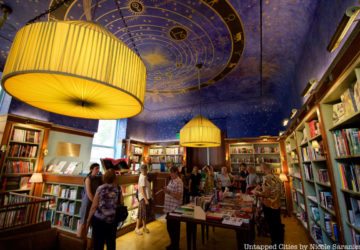
Marked only by a small tin sign hanging from the storefront, The Drama Bookshop on W. 40th Street is worth a visit, even if you’re not an aspiring thespian or filmmaker. Clean and full of light, this store bears little resemblance to, say, the tables stacked high with bootleg screenplays run by scruffy, odiferous guys in broke-down creeper vans that lurk just outside of Tisch and Union Square. It’s clearly designed to be an artist’s resource–the shop’s merchandise includes books like Backstage’s Call Sheet (formerly called the Ross Report) and publications like  Theatrical Index  and  New York City Casting Directors. The shop even sits on top of a performance space called the Arthur Seelen Theatre, where the staff hosts events and plays multiple times a week. Plus, any place that sells something as random and kick-ass as an Oscar Wilde action figure is good in our book.

7. Murder Mystery Mafia Dinners

We got drawn in here by the fun bookshelf wallpaper on the balcony level of Arno Restaurant (141 W. 38th Street), and then discovered that the restaurant hosts a 3-course murder mystery dinner theater called Murdered by the Mob. We haven’t tried it yet, but it’s on our list.

8. Subway Shops

You can find little shops in subway entrances in different places throughout the city, but I still find them interesting whenever I come across them. This is the barber shop on W. 40th and 7th Avenue, just under Midtown Comics.

Barber shop in the subway entrance at W. 40th Street and 7th Avenue

And a slightly less wholesome sex shop and DVD store in the entrance of the A/C/E in 40th and 8th Avenue:

Sex shop in the A/C/E subway entrance on W. 40th Street and 8th Avenue

9. Art Nouveau in the Garment District

Websites like ScoutingNY and New York Press have all covered this little gem, but it’s always a pleasure to see it in person. It’s designed by Emery Roth, the same architect as the Central Park West San Remo apartments. According to New York Press, “in the 1930s it was a cigar store and later it was home to one of  the gang members associated with the much-publicized “Capeman” killing  in Hell’s Kitchen,” in recent years it was a sex shop and since 2010 it’s been a pizza shop, but the DVD lingerie shop still occupies a small portion of the storefront.

Get in touch with the author @untappedmich.


12/05/12 2:04pm

Screenshots of Untapped Cities as displayed on the new SPUN app

Untapped Cities is excited to announce a partnership with the new mobile phone app, SPUN, created by the team from Broadcastr. They’ve built upon their impressive list of relationships with institutions like the 9/11 Memorial, Lincoln Center and NYC Parks, and created this geo-targeted news app that curates content from hundreds of local sources like Untapped Cities, Gothamist, Eater, Racked, ScoutingNY, Humans of New York, and many more. They’re currently in 11 cities, including many of those Untapped Cities covers, like New York, San Francisco, Austin and LA.

We think it turns the app Foursquare on its head, banking on the fact that people are interested in stories first and foremost, then by location. The articles pulled by the SPUN editorial team are chosen based on uniqueness of content first and then cross-referenced for popularity.  Fittingly, when Scott Lindenbaum, President and COO of SPUN showed me the new app, we didn’t meet in an office. I took him to one of my favorite hidden spots in New York: the freight entrance restaurants of the Garment District. Urban curiosity drives the SPUN team.

Our picks for the top 10 Bookstores in Manhattan, as mapped out on SPUN

The best part though is how the app navigates through an article. Take our piece on the “Top 10 Bookstores in Manhattan.” The map at the top of the screen moves as you scroll down the article past the different bookstores. You can save articles and locations, which will pop-up the next time you’re nearby, and share the content through your social media platforms.  The app, developed in partnership with Apple, is driven by great imagery, and is the first we’ve seen to eliminate the pesky topbar on the iPhone.

Check out the Untapped Cities recommendations for the top 10 Bookstores in Manhattan and more on SPUN. Get in touch with the author @untappedmich.


11/27/12 11:30am

The story of the neighboring districts of Little Burgundy and Saint-Henri is an oft-told one. Both are working-class neighborhoods that were lively in the thirties and forties, but went into decline after new road infrastructure (like the  Turcot interchange)  isolated them during the urban renewal efforts of the sixties. Artists and young entrepreneurs eventually started moving into the area, attracted by the cheap rent and (potentially) beautiful buildings. Now, gentrification is starting, but at a fairly slow rate.

Historically, it was in Little Burgundy that much of Montreal’s internationally renowned jazz scene developed. Starting in the 1880s, the area was home to a large part of Montreal’s black community, most of which worked on the nearby railroads. Music was an important part of their daily lives, be it at church or in the many music clubs around the neighborhood.  During the Prohibition era, musicians like Duke Ellington, Sarah Vaughn and Dizzy Gillespie regularly crossed the border and came to Little Burgundy/Saint-Henri to enjoy the crazy nights at popular cabarets like Rockhead’s paradise or Café Saint-Michel.

Today, most of this community has split up and moved to other parts of the city but its past presence can still be felt in subtle ways. For example, parks and buildings have recently been renamed to honor famous local jazz musicians like Oliver Jones or Oscar Peterson.

A few noteworthy spots from that particular era are still standing, but abandoned or in dire need of renovation, like the former  community center  turned into a street art hotspot, or the Union United Church, which has hosted gospel concerts and conferences by Desmond Tutu and Nelson Mandela.

Today, efforts are slowly being put together in order to keep them up and instill a new breath of life into them.

Art has also been incorporated more officially into public spaces in Little Burgundy. The Art Deco Atwater Market building, selling fresh produce and meat since 1933, is located right on the edge of the Lachine Canal, a popular spot for cycling trips and summer picnics. On a terrace between the market and the water’s edge, there is an installation by Montreal-based Polish artist Jacek Jarnuszkiewicz. Each of Les Allusif‘s eight stainless steel sculptures refers to one aspect in the surrounding neighborhood’s history, partly focusing on its musical heritage (represented by two side by side pianos facing opposite ways).


Notre-Dame Street is at the center of Little Burgundy’s revival. Though the street runs through more than 22 miles of Montreal, the section of Notre-Dame Street that passes through Little Burgundy has its own nickname and personality, having long been known as “Antique Alley” because of the clustering of antique shops.  In the last decade, trendy record labels, non profit organizations and restaurants have also settled here. Two of Montreal’s most hyped eateries, Joe Beef and Burgundy Lion are attracting tourists and locals alike to the area.

Finally, also standing on this stretch of Notre-Dame street is the Théâtre Corona. The former movie theater turned concert venue was built in 1912 and has a distinctive cast-iron and ceramic facade and a luxuriously decorated interior.

Left to abandon between 1965 and 1987, it was then used by artists Martha Fleming and Lyne Lapointe as a setting for their art installation La Donna deliquenta  (Be sure to check out this link to see beautiful pictures of the interior before it was restored).  This event marked the moment when the old theater came back into public  consciousness.

A decade later, it was bought and restored by a non lucrative arts corporation. Nowadays, it is a popular spot for intimate concerts (it has a capacity of 750 people), hosting local indie bands as well as household names (Patrick Watson, The Raveonettes, Steve Earle and Sleigh Bells have all played here in 2012).

Today, residents continue to embrace Little Burgundy as home and are proud to be part of its revival. Even for those that don’t reside there, it has been a pleasure to see how creative and inspiring its rebirth has been.

11/12/12 1:59pm
Monuments Madrid

20th century apartment buildings, churches and medieval cathedrals fill the skyline of Madrid, Spain.

Madrid is littered with centuries’ old buildings and offers the architect and the foodie a welcoming respite from walking through the no-shade sun drenched Indian summer or sleet-ridden wintered worn streets and plazas.

Croquetas and Bacalao from Casa Labra

Entrance Casa Labra MADRID

A multitude awaits entrance into Casa Labra, home of fried fish and national brews.

Since the Middle Ages travelers reached Madrid by horse or stagecoach in anticipation of the taverns that awaited them. Today, smack dab in the epicenter of Puerta del Sol, one can still quench the thirst and hunger assumed by far and wide travel. Established in 1860, and frequented by the  Spanish Workers’ Socialist Party  founded in this very spot 1879, Casa Labra continues to dish out hot meals and tap out draft beers.

Cod croquettes and fritters Madrid

Fried cod (front) and cod croquettes (back) are the specialty of the house at Casa Labra.

Don’t be fooled by the appearance of this restaurant/bar/food-stop listed in almost every guide book on Earth, in fact it’s a Madrid institution. Whether or not you have been introduced to salted and dried cod fish, you’ll quickly learn that  bacalao  is an essential element of a Spaniard’s diet. This place specializes in it; frying up some of most famous cod fritters and cod croquettes this side of the Atlantic. In standard Madrid fashion, it’s open late and fills up fast, so be prepared to queue.

Calle de Tetuán 12
Madrid Spain 28013
[map]

Tapas at Mercado de San Miguel

Gourmet market San Miguel Madrid

Where wine flows like water. El Mercado de San Miguel, Madrid, Spain.

Finding a shop to make your sandwich on the premises while you browse the gefilte fish and bagel offerings will not be a discovery in Madrid, at least not in this day and age. That being said there are popular and historic markets speckled throughout the city that appease locals and guiris alike with an array of tapas and bite-size finger foods to enjoy along the bar, or wherever you can manage to elbow your own personal space. El Mercado de San Miguel, an iconic 20th century steel covered market, is just the spot for this Madrid experience. And since you can pretty much drink anywhere in Spain, it’s also an excellent location to pair your snack with a glass of wine (vino del paà­ ­s). On Sundays – unlike most storefronts – the Mercado de San Miguel is busier than ever.

Exterior Mercado San Miguel

Situated next to Plaza Mayor, Madrid’s covered market, El Mercado de San Miguel, serves as a delicious and beautiful example of the city’s architecture and gastronomy.

Arrive early for a unique “brunch”  of raw shucked oysters and  cava  (the Catalan equivalent to champagne), plates full of jamón ibérico and Manchego cheese or even pick out your fish from one of the vendors and watch them prepare it onsite. However, there is much more than meets the belly; gourmets can browse the gastronomic bookstore, the architecture (modeled after the original Les Halles Paris) impresses any Ebenezer Scrooge and the  ambiance  of people’s excitement to be sharing what they love best – company and food – rises above all.

Plaza de San Miguel
Madrid Spain 28005
[map]

Dessert or Breakfast Pastries at Horno del Pozo

Horno El Pozo Madrid

Hungry? Why wait? Pastries tempt passersby at Horno del Pozo, Madrid.

Spaniards may claim to be fit and healthy, abiding strictly to a Mediterranean or a fresh food lifestyle, but truth be told they are huge sweet enthusiasts. Breakfast generally consists of a coffee with milk and sugar or a hot chocolate with some sort of pastry. Also let it be known that the entire country takes an essentially mandatory snack time break at 5pm, the merienda, which is a calorie packed way of tiding over growling stomachs until the late Spanish dinner at 10pm. This mini-meal is almost always a sweet – especially for children – and could be a muffin, a small bag of cookies, or a bread roll smeared with Nocilla  (the Spanish branded version of Nutella).

More and more, as industrialized products “facilitate”  our lives, the once homemade sweets mentioned above are now being processed, packaged and sold in Costco-style sized bags for quick, easy and mindless consumption. To find a bakery that continuously puts the time and effort into baking treats worthy of calorie consumption is getting more difficult. That said, Horno del Pozo is a living example of tradition frozen in time, the year 1830 to be exact. Walking past the shop will put our glycemic indices on high – in a good way. Walking past without entering however, would be a crime. Marvel at the well kept marble counter, chat with the owners, steal a peek at the antique cash register (still in use!) and certainly grab a treat for the road.

Antiguo Horno El Pozo MADRID

A little piece of history remains functional at Antigua Pasteleria El Pozo.

Calle Pozo 8
Madrid Spain 28012
[map]

Get in touch with the author  @jamon_y_vino

11/01/12 2:30pm

The architectural boat tour sponsored by the American Institute of Architects (AIA) New York chapter is arguably one of the most informative and enjoyable tours in New York City. The Classic Harbor Line is docked at Pier 62 in Chelsea and the boat is the picture of elegance. The ship’s deck is made of fine teak and the interiors are plush and comfortable. Architect Anthony Platt, who seemed no stranger to the microphone, gave the tour. He rattled off dates, names and architectural styles with the same ease as reciting the alphabet. His knowledge seemed to know no bounds and it was actually difficult to keep up with all the information, though still enjoyable nonetheless. As we pulled out of Pier 62, he told us that Chelsea Piers is over one hundred years old and began as a luxury liner pier. The Titanic was scheduled to dock there, but the survivor ship, The Carpathia, took its place. After the height of luxury liners came to an end, the piers were turned over for shipping and fell into disuse in the 1970s. In the 1990s, the piers were rehabilitated for adaptive reuse as seen today as the mega-sports complex, Chelsea Piers.

As we pulled out of the boat slip and into the Hudson River, the West Side of Chelsea came into full view. Recently Chelsea has seen a surge of starchitecture and the viewpoint from the water was a different way to see how it all comes together against the skyline. Our tour guide started out by pointing towards the wonderful Jean Nouvel residential tower, noting the 1,700 different panels all situated in different directions to give the illusion of different shades of blue. We were then pointed towards the iceberg-esque Frank Gehry building, home to the IAC. The glass was warped into shape and then sprayed down with silicone to give it its ghostly appearance.

As we floated down the river, Mr. Platt was quick to point out architecturally significant buildings both old and new. We moved from recent history to older with the Westbeth Artist Community, a building whose beginnings started as the Bell Laboratories and is one of the first examples of adaptive reuse in the city. It opened in the late 1960s as artist live-work studios for 384 individuals. The project was the first important public commission for Richard Meier. In 2011, the building was marked as a New York City Landmark.

Naturally, the new World Trade Center was highlighted on this tour. The mega architecture firm S.O.M. is in charge of the design, following Daniel Libeskind’s master plan. Four World Trade Center is designed by Fuki Mahki and will prove to be another interesting addition to the lower Manhattan skyline. The new Goldman Sachs tower was pointed out on both the Manhattan side and the New Jersey side. I.M. Pei’s firm designed the Manhattan tower and the New Jersey office is the tallest building in the state, though few from Goldman Sachs actually use those offices.

We moved towards the tip of the island towards Battery Park City, a former landfill. Work began on this section of Manhattan around the same time as the original World Trade Center. New York State created the public-private Battery Park City Authority to build the development. One notable structure is the ziggurat-like Jewish Heritage Museum. This building surely is unique in style among the hundreds of New York City structures and serves as a great homage to Jewish people and their heritage.  Moving forward, we rounded the island and headed up the East River towards the Harlem River. Obvious important structures were pointed out like Frank Gehry’s residential tower, “New York by Gehry” and the Brooklyn Bridge.

The newest addition on this tour perhaps was the new FDR Four Freedoms Park at Roosevelt Island. The tip of the small island has been made captivating and serves as a nice, fresh juxtaposition from the ruins of the old small pox hospital. New Yorkers have another reason to visit the East River island.

Moving towards High Bridge Park we were informed of Bette Midler’s involvement through the New York Restoration Project in cleaning up and restoring this park perched on a cliff. For a moment it feels as if you are way up the Hudson River and not Manhattan, especially when you come upon the boathouse designed by Robert A. M. Stern. Its bright colors are a welcome respite from the relentless glass and steel seen earlier.

As we trolled through the no wake zone of the Harlem River, Mr. Platt pointed towards Columbia University’s playing fields and a cliff that children are wont to jump off of in the warm summer months. The beautiful fall foliage helped to transport us out of Manhattan once again. We passed the Cloisters and were reminded of just how much the Rockefellers contributed to Manhattan’s glory both now and in time past.

Passing midtown Manhattan, we saw the new development in the beautiful starchitecture towers of Sir Norman Foster, Robert A. M. Stern, Renzo Piano and other well-known mega firms. The recession seems to be over in Manhattan by evidence of the countless cranes and construction sites. The new development initiated by Donald Trump has done much to change the long empty portion of the East Side waterfront. As we pulled back into the slip at Pier 62, I was reminded that it was a Friday and I wasn’t on vacation. The 2 hour 45 minute trip was over and I needed to get back to my workday, sadly. All in all, this is a tour that I would highly recommend to both tourists and New York residents alike. It isn’t for the faint of heart though. Be ready to learn more in a short period about architecture then you ever thought possible. It just may send the architecture novice’s head reeling but there’s one free drink if this may cause some anxiety.

Find out more about the AIA New York Chapter and the Center for Architecture.  

10/30/12 10:18am

If the horror of Frankenstorm has not spooked you enough, the Haunted Pumpkin Garden at the New York Botanical Garden in the Bronx has just what you need to awaken the fear and cheer of Halloween. This year, expert pumpkin carver, Ray Villafane, went wild on a series of giant pumpkins. Following a short walk through the garden’s tree-lined paths awaits creepy, crawly pumpkin spiders littering ivy, a whopping 1,872 pound pumpkin, and a gut-leaking creature ripping frightened pumpkins from their roots. These artful creations will be on view until Halloween day so act fast and get into the macabre spirit!

For more information on the Haunted Pumpkin Garden see the official New York Botanical Garden website.