

Last-Minute NYC Holiday Gift Guide 🎁
We’ve created a holiday gift guide with presents for the intrepid New Yorker that should arrive just in time—
We’ve created a holiday gift guide with presents for the intrepid New Yorker that should arrive just in time—

From lobster traps to origami animals, discover how quirky trees are decorated across the five boroughs!


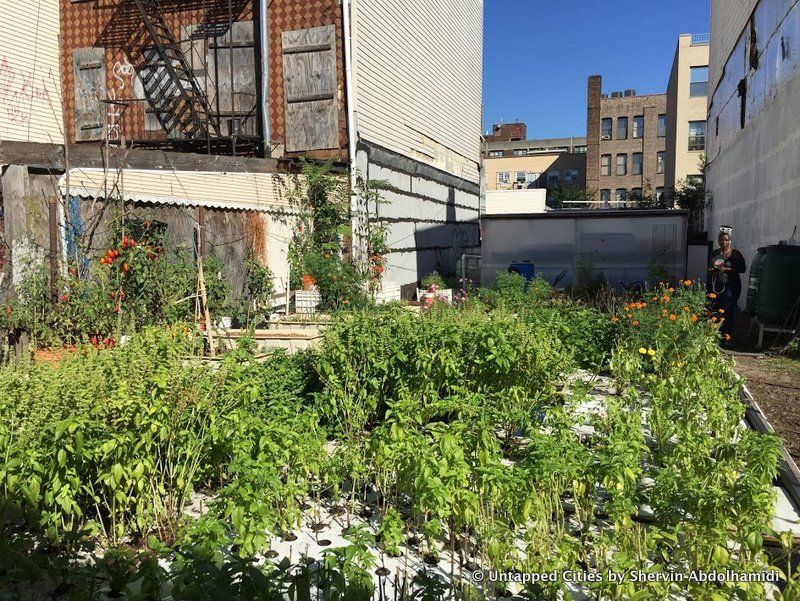
New York City is a bustling metropolitan of skyscrapers, subways, and cabs, best known for its dazzling skyline, scintillating night scene, and frenzied streets. And yet, amidst this motley of buildings, infrastructure, and city life, where nature seems sparse and difficult to come by, lies a multitude of indoor farms and gardens—a means of respite for those seeking nature, and an uncommonly known alternative agriculture scene.
While conventional, industrial farming has been ongoing in the United States for generations and is still thriving, in the wake of population growth, diminishing resources and the inefficiencies of traditional farming, there has been an advent of urban farming and surge for sustainable agricultural methods that is gradually coming into the limelight. Spawned by the trending desire for fresh, locally grown produce, and greater efficiency, urban farming—which consists of rooftop farms, indoor greenhouses, aquaponics, etc.—has been gaining prominence in many cities around the world, such as Vancouver, London, and Chicago.
In addition to the rooftop and urban farms around the city, there are other alternative agriculture sites around the city which employ methods of hydroponics, aquaponics and aeroponics for energy-efficient and sustainable farming. Hydroponics is a soilless agricultural technique that involves the usage of mineral solutions. By cycling and reusing the water in mineral solutions, not only does this method drastically reduce water waste, but it also mitigates the risk of food diseases by eliminating the possibility of soil-based pathogens.
Moreover, another method that combines hydroponics with conventional aquaculture (raising aquatic animals such as snails, fish, etc. in a tank) is aquaponics; aquaponics is the process of utilizing aquatic animal’s excretions as plant nutrients. The plants in turn filter the toxic waste from the water, which is then recycled through the system. While currently 70% of the world’s freshwater is used for industrial agriculture, this closed loop system significantly reduces water usage—thus providing a sustainable means of farming as we contend with diminishing freshwater sources. While not known to many, New York City has a few hydroponic farms of its own.
Alternative agriculture is not as prevalent in New York City as elsewhere; however, a 2010 New York State report proclaims that New York City alone has a $600 million unmet annual demand for local food. As more and more New Yorkers become concerned over the provenance of their food, these novel and more sustainable means of farming—which provides city dwellers access to fresh produce, rather than two-week-old truck-bed rattled fruits and vegetables—is coming into the limelight of New York City.
Here are the ten of the most urban farms and alternative agriculture sites in New York City:
Based inside a nondescript warehouse on the border of Bedford-Stuyvesant and East Williamsburg, VertiCulture is utilizing aquaponics in a vertically designed system. They are able to raise Tilapia fish—which they provide to their customers within hours of harvest—and concurrently grow a diverse assortment of fresh produce that they deliver to their customers.
Since March 2015, VertiCulture has been operating out of in 630 Flushing Ave, the old Pfizer factory, a manufacturing plant that was shut down in 2008 and redeveloped into small manufacturing and office space. Verticulture currently cultivates 150 to 180 tilapia and produces between 30 to 40 pounds of basil a week, which are sold to local retailers.
Located in Bushwick, Oko Farms—the oldest aquaponics venture in Brooklyn—is also the largest outdoor aquaponics farm in New York City. Oko Farms cultivates freshwater fish such as catfish, Tilapia, and Crawfish, along with a variety of fresh produce and herbs—a sustainable, organic system whose only input is the fish food.
Oko Farms currently supplies fresh produce to the neighboring Moore Street Market. However, given the complications of outdoor farming, Oko Farms is looking to expand into an indoor location where they can procure their produce unhindered by inclement weather.
From August 20th through September 24, Oko Farms has one-day workshops where visitors can learn about aquaponics design concepts, fish care, and plant propagation. Moreover, there are guided-tours for New York City youth that familiarize students with these modern, alternative farming methods.
Founded over ten years ago in the Finger Lakes area of New York State, Aerofarms now owns the largest indoor annual farm in the world, based on growing capacity. Their global headquarters in Newark, New Jersey is set to produce up to two million pounds per year of produce which will be supplied to the New York area.
By growing plants in their fully-controlled, indoor facilities, Aerofarms is capable of commercial-scale production all throughout the year, unhampered by weather and seasonal patterns—factors that conventional industrial farming is susceptible to. By situating their facilities in close proximity to major cities and major distribution routes, they are able to deliver locally grown produce to the market fresh. Moreover, by employing aeroponics (the method of spraying plant roots with a nutritious mixture) Aerofarms is able to reduce their water consumption by 95%, compared to field farming.
Aerofarms currently has four farms in the Newark area—including one on the Phillips Academy Charter School campus—and have farms in development in multiple states and on four continents. As of now, numerous restaurants in the area purchase their greens for Aerofarms and its produce is also available for purchase at a retail level in grocery stores like Shop Rite.
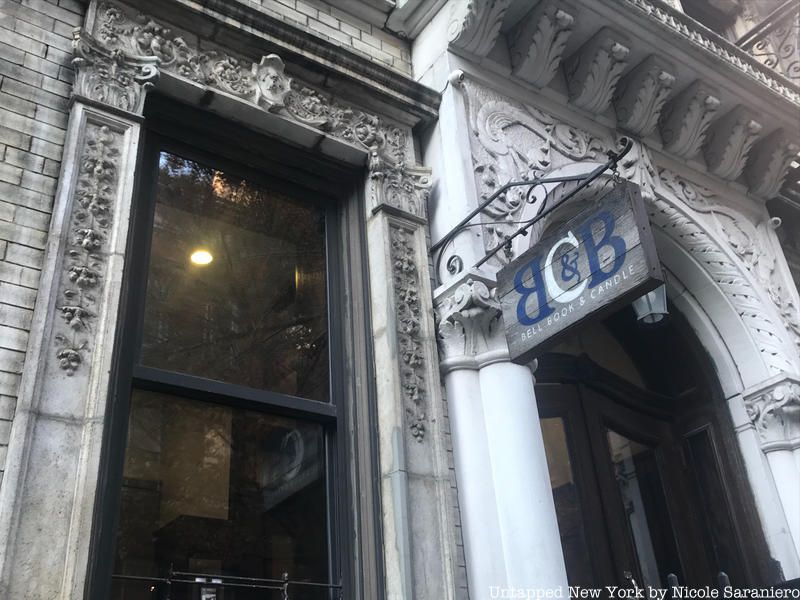
Situated in a quaint neighborhood of the West Village, Bell Book and Candle is a restaurant whose menu cycles significantly throughout the year. This is in large part due to a rooftop garden at the restaurant that procures a major portion of the produce that they cook with.
While Bell Book and Candle’s food “strives for an element of originality and individualism,” their food “revolves around local, organic, sustainable and overall responsible procurement.” By using an automatic hydroponic system on a vertical structure, the restaurant—the first New York City restaurant to employ a rooftop garden—grows a plethora of vegetables such as strawberries, squash blossoms, heads of romaine and Bibb lettuces, chickpeas, and more.
In addition to supplying over 60% of the produce for the restaurant, the hydroponic technique engenders a faster growth rate for the plants, such that the lettuce grow 25% faster than conventional lettuce. Since the inception of the restaurant in 2010, numerous other restaurants have taken heed and employed their own rooftop garden.
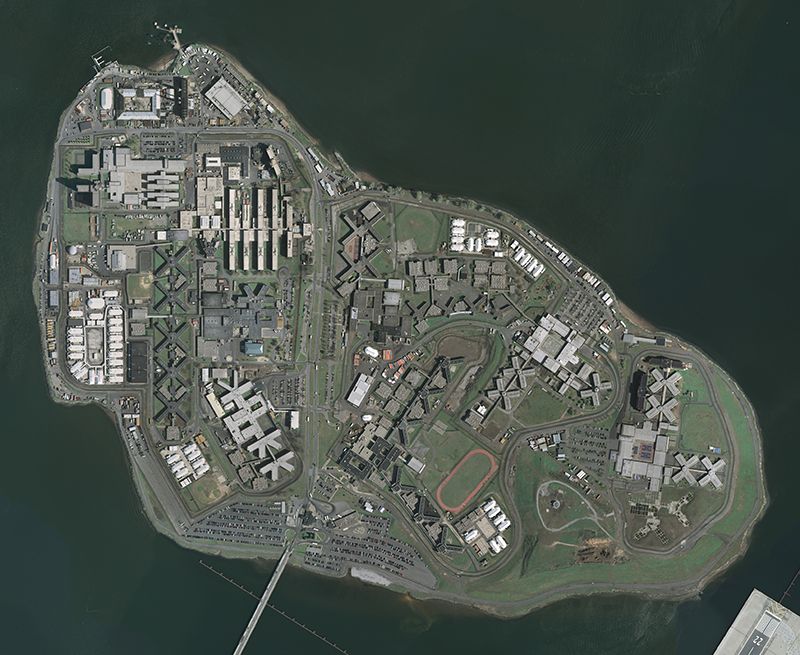
Image via Wikimedia: U.S. Geological Survey
On the East River, between Queens and Bronx, sits the foreboding and unforgiving Rikers Island. Serving as New York City’s main jail complex for over 80 years, Rikers Island hosts an average daily population of 7,600 inmates—some serving short sentences, some awaiting hearing and unable to pay bail, and some waiting out detention while undergoing their trial; yet, this island is also home to an urban farm that we previously covered.
Run by the Horticultural Society of New York since 1996, the GreenHouse Program offers vocational training and horticultural therapy for inmates within their greenhouse facility. Here, inmates are able to spend time raising plants, learning gardening skills, and fulfilling the GreenHouse programs’ goal to create a meaningful connection between people and plants. See the greenhouse here.
The Eagle Street Rooftop Farm is a 6,000 foot organic green roof vegetable farm located on a warehouse rooftop in Greenpoint, Brooklyn. During the growing season Eagle Street Rooftop Farm has an on-site market where patrons can directly purchase their freshly grown, organic produce. Sprawling across the rooftop of Broadway Studios where Master of None and Unbreakable Kimmy Schmidt are filmed is this amazing Eden which has been growing a diverse assortment of vegetables, fruit, rose and even chicken since 2009. Broadway Studios is itself an adaptive reuse of a building within the ExxonMobil plant, situated inside the Greenpoint Oil Spill Remediation area.
In addition to visiting hours on the last Sunday of every month from May to October, Eagle Street Rooftop Farm—which is eminently known as the first commercial green roof farm in the United States—also accepts apprenticeships and internships for urban farming aficionados.
Similar to the Rikers Island’s farm, whose predominant purpose is not production of produce, the 40,000 square foot urban farm at the southern end of Randall’s Island is more of an outdoor classroom. The farm gives children the chance to learn about sustainable farming methods while working among the two greenhouses, four rice paddies, 80 raised beds, and a garden consisting of milk crates. The urban farm also harbors two pear trees, numerous grape vines, and even ten baby chicks, which are purchased and raised in the garden.
Read more about the Randall’s Island Waterfront Garden here.
Aboard the Metro North Train, as you cross Manhattan and enter the Bronx, amidst the myriad of building you may notice a sliver of what hold the semblance of a farmland. This pocket of farm, encroached between Metro-North Railroad tracks and a congested highway teeming with cars, is called La Finca Del Sur/South Bronx—an urban farm coop that’s operated by women of color from the Bronx. These community members have transformed the three acres of land into an urban farm, along with a farmer’s market, children’s educational programs, and even a performance space.
The farm was founded in the late winter of 2009 by a group of community members and organizations who envisioned the decrepit, vacant three acres of land to be something more. As they write, they are committed to “building healthy neighborhoods through economic empowerment, increased nutritional awareness, training and education, and advocating for social and political equality and food justice in low-income communities.”
The farm grows a diverse array of fruits and vegetables, thus reflecting the various ethnic backgrounds of the volunteers who work there. Some of the produce include: mint, Russian sage, English thyme, red lettuce, and more. La Finca Del Sur exemplifies the impact of urban farming as a means of unifying a community and providing numerous means of education, and recreational activities for the families and children of the neighborhood.
Gotham Greens is an indoor farm with sites in Brooklyn, Queens, and Chicago that uses renewable energy powered greenhouses and hydroponic techniques to produce organic and fresh produces. Established in 2009 in Brooklyn, New York, Gotham Greens has currently operates over 170,000 square feet of urban rooftop greenhouses across four facilities in New York City and Chicago.
Using 100% renewable energy fueled greenhouses and highly efficient production techniques, Gotham Greens is capable of producing 50% more crop than conventional greenhouses while using 25% less energy per pound of crop. Moreover, by utilizing recirculating hydroponics, their irrigation system employs the most efficient method in the world. Gotham Green’s products can be found all around various stores in Brooklyn and Manhattan. A full list of their retailers can be found on their website.
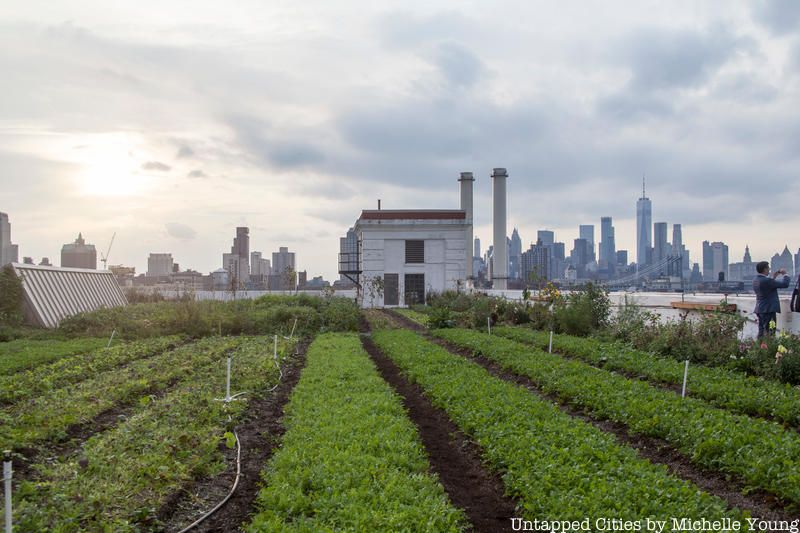
When it comes to urban farming, one of the most eminent of these farms is Brooklyn Grange. With their flagship location in Long Island City Queens, and their second farm in the Brooklyn Navy Yard, Brooklyn Grange boasts the largest rooftop soil farm in the world with over 50,000 pounds of organically-cultivated produce a year.
Brooklyn Grange started in May of 2010 in a warehouse building on Northern Boulevard. The mission of the team is to “grow food on the rooftops and unused spaces of New York City,” thus offering fresh, organically grown produce to New Yorkers, local restaurants, and CSA members, while maintaining a “fiscally sustainable model for urban agriculture.”
They have also expanded beyond vegetables – Brooklyn Grange now keeps egg-laying hens. They are involved in non-profit, educational activities; 17,000 New York City youths visit each season for workshops and tours—thus getting exposure to farming methods, gaining appreciation for the process of farming, and learning about sustainable urban agriculture.
Brooklyn Grange has weekly open houses at their flagship location on Northern Boulevard where visitors can buy produce, get their hands dirty doing some farm-work, or just stroll along the paths and admire this remarkable little oasis of agriculture, nestled among the arid, concrete jungle of the city.
With the planet’s diminishing natural resources, urban farming could become paramount in decreasing our food footprint. Our city’s dependence on the import of foods has been underscored in the aftermath of catastrophes such as 9/11 and Hurricane Sandy. Alternative urban farming is a fascinating, up and coming field that not only provides New Yorker’s with fresh, organic produce, but also bolsters our independence and food security in the wake of unforeseen circumstances.

Subscribe to our newsletter

