
Arts & Culture
See a Forgotten Michelangelo Sculpture at The Met in NYC
For almost a century, this example of the great master's early work went unrecognized!
For almost a century, this example of the great master's early work went unrecognized!

Uncover stories of NYC ghosts from A Haunted History of Invisible Women!

Long before fiber optics and wireless networks, bursts of compressed air kept Wall Street moving.


The Metropolitan Museum of Art is home to an unparalleled art collection, for which guides abound, but this list of secrets will explore how the Museum as a building is like none other in the city. It’s about its architecture, its rich history, and the hidden gems to look out for on your first, second, and umpteenth visit to the museum.
Rather than one building, the Met is more like a jumbled collection of wings and various building campaigns. Over almost a century and a half, several prominent architecture firms played major roles in the museum’s growth, while many others also had a hand in the countless modifications, renovations, and additions that make the Met what it is today.
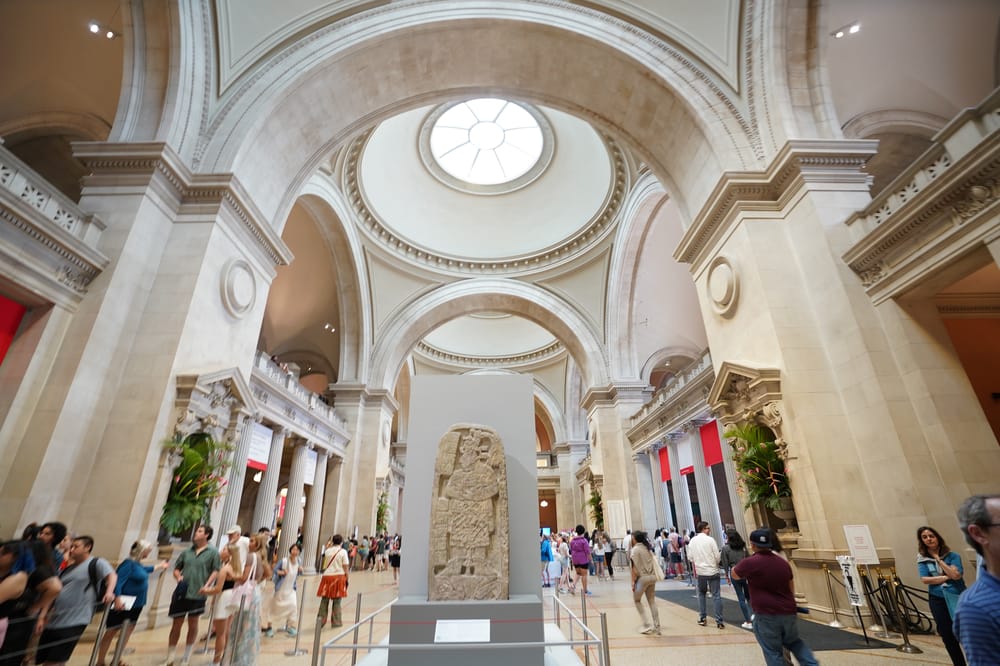
Multiple Dates at 10:30 am ET: Encounter breathtaking masterpieces and overlooked treasures whose stories span continents, cultures, and millennia!
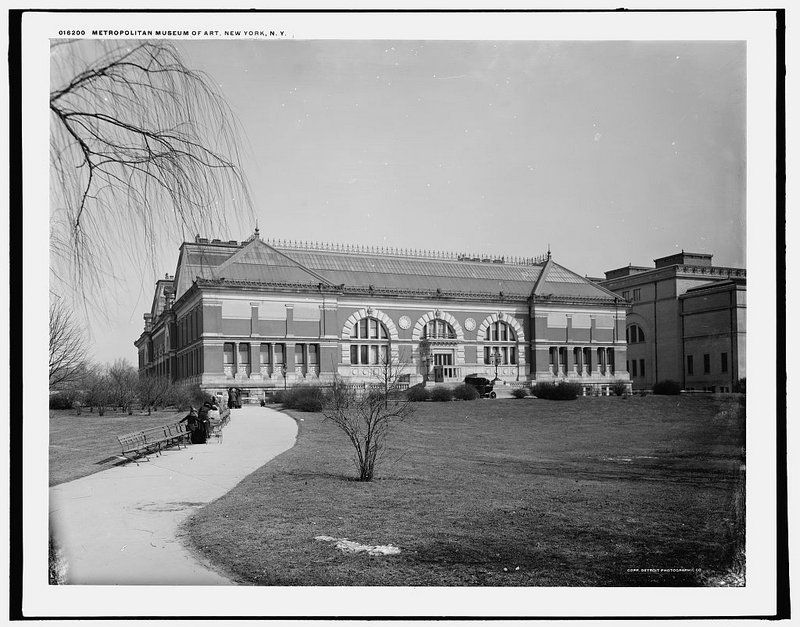
The first Metropolitan Museum of Art was located in a brownstone at 681 Fifth Avenue. Next, it was moved to a mansion at 128 W 14th Street. Both were temporary locations until a permanent facility could be built. A Central Park location for the museum was first hinted at in 1869 by publisher George P. Putnam, but the designers of Central Park – Frederick Law Olmsted and Calvert Vaux – were opposed to the construction of public buildings within their carefully crafted naturalistic landscape.
Eventually, they conceded one spot in the park under the condition that any large buildings placed there would be “seen from no other point of the Park – while the whole of the territory thus enclosed was too small for the formation of spacious pastoral grounds.” [Morrison H. Heckscher, “The Metropolitan Museum of Art: An Architectural History”]. This spot was the current location of the museum along Fifth Avenue. You can see original plans for the museum on the Met’s website.
When construction began on the museum’s new location at Fifth Avenue and 82nd Street, the area was significantly north of what was considered “desirable” during that era. In fact, it was predominantly farmland, far from the mansions of the old money set and new robber barons. The grid plan was already laid out, but the streets weren’t yet paved that far north.
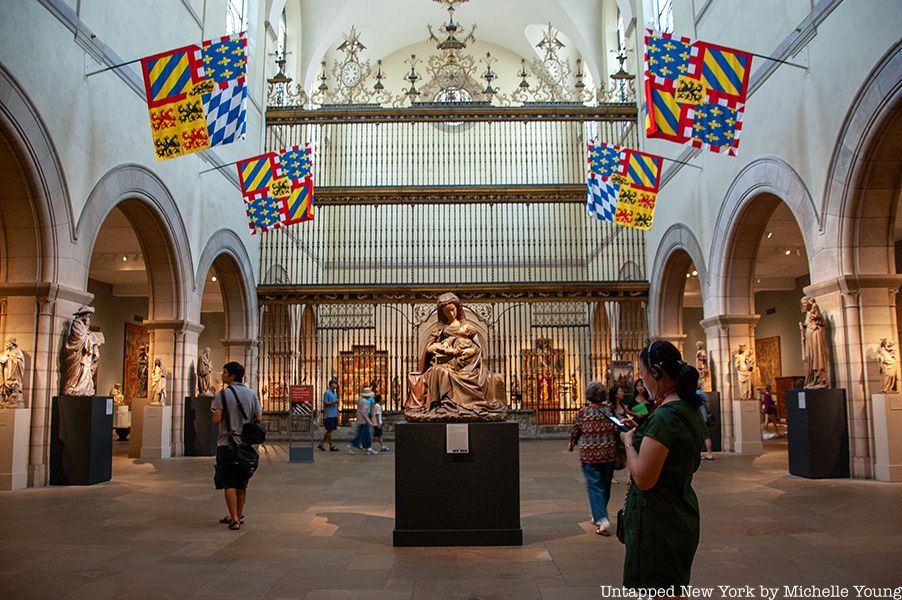
Calvert Vaux (with Jacob Wrey Mould) was given the commission to design the first wing of the museum. The Medieval Hall (Gallery 305), which is in the center of the museum complex today, was the first wing built and is now surrounded by extensions on all sides. It was completed in 1880, and the interior looked very different than what we see today. The Romanesque-style interior that present-day visitors know actually dates from a 1930’s renovation.
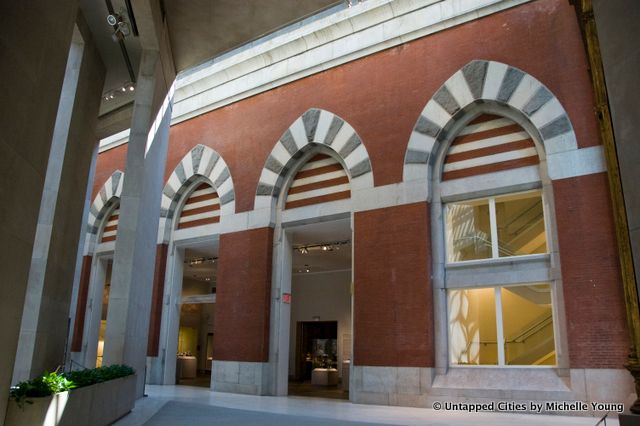
You can still see Vaux’s original Victorian Gothic façade in various places, like in the Robert Lehman Wing (Gallery 961/962). Originally, the façade pictured above would have looked onto Central Park. In the second-floor passage that leads from the Grand Stair south towards the Impressionist wing (Gallery 690), you can catch another glimpse of the original façade peeking out. This elevation once faced east towards 5th Avenue.
The unique cast-iron staircases flanking the east end of the Medieval Hall, rarely used but publicly accessible (from Gallery 304), are also remnants from the original Vaux building. Theodore Weston and Arthur Lyman Tuckerman added a wing to Vaux’s original building in 1888, and another in 1894. The Petrie Sculpture Court (Gallery 548) exposes Weston’s south façade and the grand portal that was the main museum entrance from 1888 to 1902. During this period, visitors entered off of the park from an entrance drive, rather than from 5th Avenue as today.
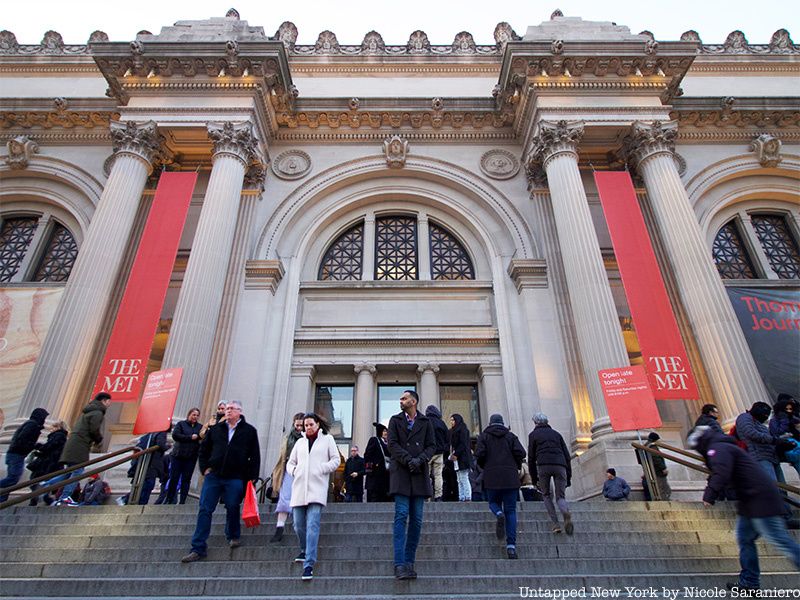
The “backstage” areas of the Met are located underground below the galleries. Art and people travel through these underground passageways as they conduct the business that keeps the museum running. There has also been room for recreational spaces, including a shooting range in the 19th-century.
According to a New York Times article from 1935, construction of the shooting range was part of a larger renovation project at the Museum with funds from the WPA. The article states that the gallery will have “targets, lockers, and all appurtenances necessary for the annual shooting contests held by the guards who watch over the museum.” These annual matches had already been taking place for several years in an improvised gallery space. You can uncover more backstage stories from the Met in Bringley’s forthcoming memoir, All the Beauty in the World.
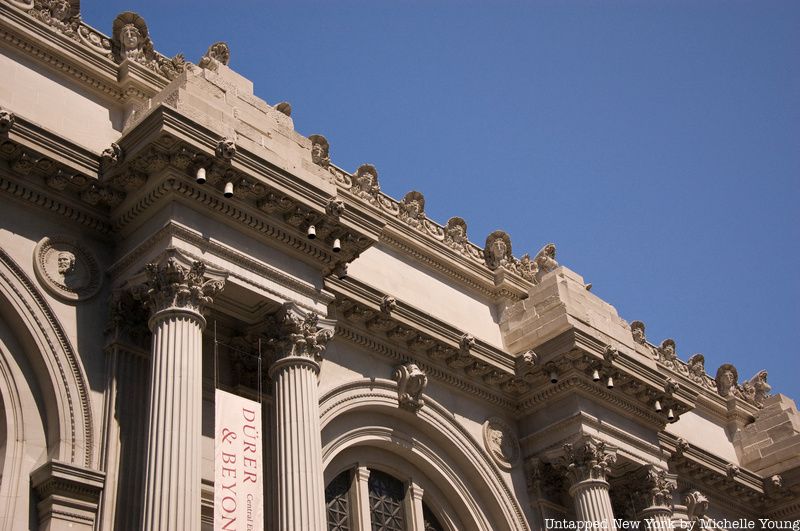
Famed architect Richard Morris Hunt was hired to design a grand 5th Avenue façade for the museum as part of a new master plan put forth in 1894, but died before construction began. This famous façade that visitors have known as the Met’s main entrance since 1902 was completed by his son, who carried out the design to almost all of his father’s specifications.
Thirty-one pieces of sculpture were originally designed for the façade, but a lack of funds left piles of uncarved stone atop the columns. These piles have since become an “accepted part of the façade.” [Heckscher] In Hunt’s original design, the four columns were to be topped by sculpture groups representing “four great periods of art: Egyptian, Greek, Renaissance, and Modern. Between each pair of columns sat a niche where Hunt intended to set a copy of one great work from each historical era.” [Gregory Gilmartin] After 117, the niches were finally filled in 2019 by a series of sculptures created by Kenyan artist Wangechi Mutu. New art commissions now rotate through this previously unused space.
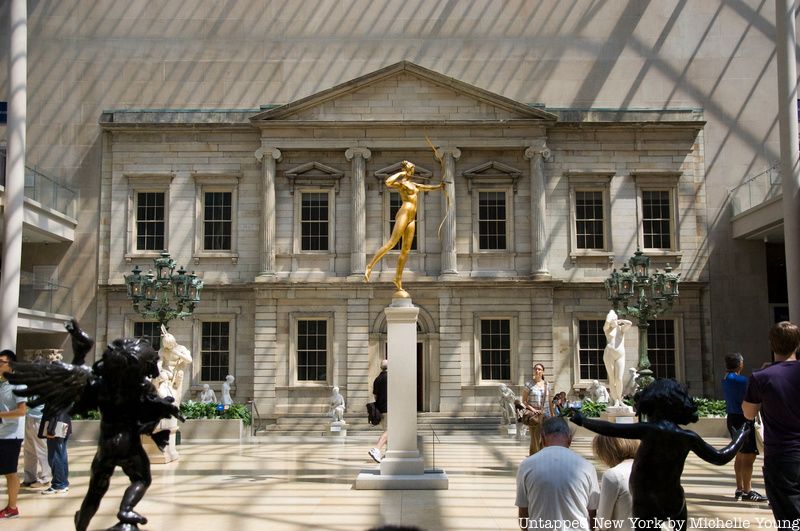
The neoclassical façade of the American Wing, curiously built into the wall of Engelhard Court (Gallery 700), was actually a freestanding building facing an exterior garden for fifty years. It was enclosed in 1980. The facade was rescued from the Branch Bank of the United States, located on Wall Street, before that building’s demolition in the 1920s.
The two Beaux-Arts bronze lampposts that stand in Engelhard Court once flanked the Bank façade. These were the original lampposts Richard Morris Hunt designed for the Met entrance. They are strategically placed in the Court, highlighting the ambiguity between nineteenth-century American art and its European influences. Another secret of the American Wing is that Englehard Court was once an open-air courtyard. One of the design principles shared by the original and subsequent designers of the Museum–Vaux and Mould, Richard Morris Hunt, and McKim Mead and White–was to use courtyards to provide natural light. Over time, these have all been filled in. With the advent of and preference for electric lighting and air conditioning, it was “no longer necessary to have interior courtyards [to] serve as light wells and air shafts.” [Heckscher]
This article is available to Supporter tier members and higher. Join for just $5/month to unlock 12,000+ stories about New York City.
Become a Supporter