

Last-Minute NYC Holiday Gift Guide 🎁
We’ve created a holiday gift guide with presents for the intrepid New Yorker that should arrive just in time—
We’ve created a holiday gift guide with presents for the intrepid New Yorker that should arrive just in time—

From lobster traps to origami animals, discover how quirky trees are decorated across the five boroughs!


The Shakespearean actor Edwin Booth, founded The Players, a members-only theater club on Gramercy Park, as a way to restore the Booth family name after his less-successful brother, also an actor, assassinated President Abraham Lincoln. The Players was founded in 1888 and is the oldest club still operating in its original location.
Booth hired renowned architect Stanford White to renovate the Greek Revival townhouse he purchased at 16 Gramercy Park South. The deed of the club, read by Booth on New Year’s Eve to the initial fifteen founding members (which included Mark Twain and William Tecumseh Sherman) provided for a furnished room in the club for Booth’s personal use. The club aimed to bring people of the arts together with those in other professions, a mission that remains to this day.
One of the most notable places in the stately townhouse is Booth’s very room, on the top floor of The Players. It has remained intact and preserved in time nearly exactly as Booth left it when he died in 1893. A specific key opens up this room, which is not open to the public normally. It’s the most off-limits place in an already off-limits club.
When you walk in, you’ll get a strong whiff of tobacco. Just under the crown molding is the hand-written phrase, “And when the smoke ascends on high, thou beholdst the vanity of the worldly stuff. Come with a puff, thus think and smoke tobacco.” The decoration is heavy, in the Victorian style with a twin-size canopy bed. There’s a day bed just next to it and other highly decorative furniture. There’s a marble fireplace and mantel, atop which sits an ornate clock and a triptych mirror. A chandelier, now electrified, lights the dark room which always has its shades down.
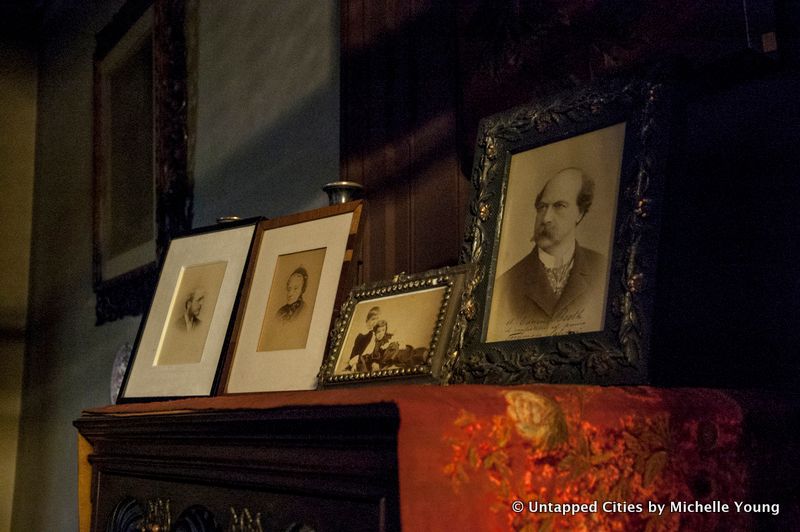
This is what you’ll take in initially until you start inspecting the numerous collector’s items in the room. The most creepy is probably the human skull that Booth used in performances of Hamlet. As Christian Campbell, a Players member who recently let us into the room tells us, the skull belonged to a horse thief named Fontaine with whom Edwin’s father, Junius Brutus Booth, also a renowned Shakespearean actor, once shared a jail cell. Fontaine was hanged for his crimes but requested that Junius receive his skull, which was shipped to the Booth home in Baltimore. On the skull itself is engraved the phrase, “And the rest is silence.” There are many more interesting things to discover inside Booth’s Room, which include photographs of his family, items he saved from his theater productions, and more.

One of the prized artworks, a painting by John Singer Sargent which had been put up as a pawn for a loan, was recovered. Lunch is served again in the club, harkening back to an era when it was a popular destination for business deals in the arts. There are after hours parties to attract a younger membership, hoping to bring back the club as a place for actors to come after their shows.
Next, see more photographs of The Players Club and read more about its history here. Discover 10 of NYC’s oldest historic clubs.

Subscribe to our newsletter
