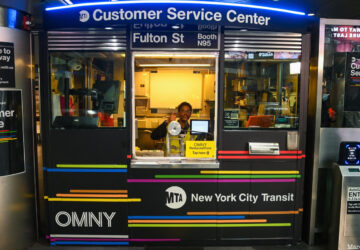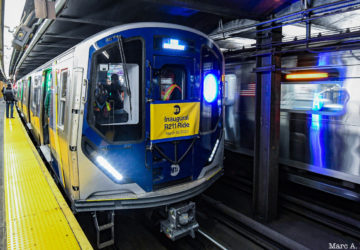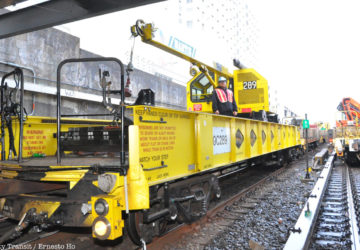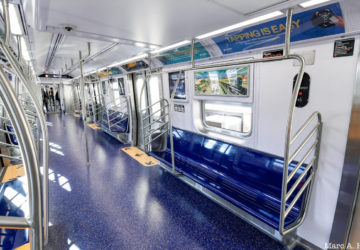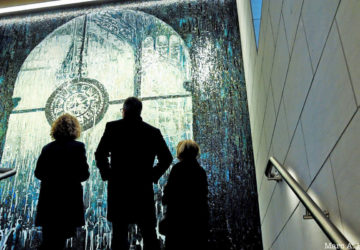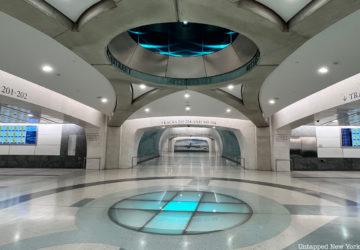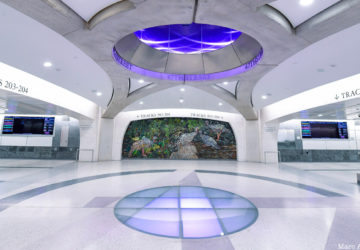


The Los Angeles County Metro Authority (or LA Metro) debuted a new 14-mile bus rapid transit (BRT) system in the San Fernando Valley in October 2005, using a former rail right-of-way. The LA Metro Orange Line was the first BRT system employed in the United States (the first in the world being that of Bogota, Colombia). Linking the western part of the San Fernando Valley with the North Hollywood Red Line metro station, the Orange Line is run on exclusive bus paths, so as to mimic the efficiency of rail systems. A 4-mile-extension in June 2012 increased the line’s reach and popularity.
As an inner city dweller, I think about where I am going before choosing my mode of transportation. In San Francisco this choice can be the beginning of all out war.
No matter what type of transportation you choose, someone is going to be mad about it. The City of San Francisco’s transportation goal is 50% of all travel within the city limits in something other than private vehicle by 2018. A laudable goal, but one fraught with animosity. Cyclists and pedestrians say that they are not listened to regarding safety (the city averages 17 pedestrian and 2-3 cyclist deaths every year). Automobile owners suggest this is an anti-car town. The number of parking spaces in the densest parts of the city is shrinking, and the number of parking meters are increasing in parts of town that never had them before. Parking meters are charging more and the metering hours are being extended to include weekends and holidays.
San Francisco is the second densest city in the United States, behind New York and in front of Los Angeles. San Francisco also has the oldest fleet of transit vehicles in North America. This has led to a decrease in service and on time performance of only 57.2% this past August. All this at a time when the riding population is increasing. Those that find public transportation can not meet their needs often have no choice but to opt for cycling or walking.
Bicyclists in San Francisco have increased by 71% since 2006 with approximately 75,000 daily riders. San Francisco is 3rd in trips to work via bicycle for major cities with populations over 300,000 and yet just under 1% of San Franciscans ride bikes to and from work. Less than .02% of New Yorkers ride bikes to work, and in the number one U.S. city Eugene, Oregon, 5.64% commute by bike. San Francisco’s overall bicycling rate looks slightly better, at 3.5 percent of all trips, this number ties for second among major American cities like Seattle, lagging only behind Portland at 6 percent.
Urban bike riding is fraught with dangers, and as a century cyclist, any cycling I choose to do within the city begins at dawn. And yet, when it comes to urban populations, San Francisco is ahead of the curve on the biking war.
Green Wave
A signal re-timing mechanism called the Green Wave, begun as a test program on Valencia Street, is now permanent. Following examples set in cities like Copenhagen, Amsterdam, and Portland, this signal optimization system keeps vehicles traveling at a steady cycle-friendly 13 mph. All-green lights provide a great convenience for bicycle travel, effectively removing the strenuous stop-and-go movement that often encourages pushing red lights. Along with pedestrians, cyclists also experience a much safer environment as motor vehicles travel at minimally fatal speeds. Additionally the Green Wave helps reduce noise and air pollution. What makes San Francisco’s Green Wave unique is that it is the first to work both ways simultaneously.
A second Green Wave was installed on 14th Street this year, and the staff from the SF County Transportation Authority plans to propose “four to six potential new Green Wave corridors along the existing San Francisco Bike Network,” with hope they could be completed in 2013.
Green Carpets
Along Market Street bike lanes are “Green Carpets” , not to be confused with the Green Wave. I first encountered this type of bike lane while riding the Tour de Tucson, and believe me I was impressed. I was thrilled to see that San Francisco is adopting this around town. The advantage of this green pavement is two-fold. The motorist is made far more aware that this is a bike lane, and the cyclist knows where to go and what to do. One of the most difficult things to navigate when riding in an urban environment is the turn. The cyclist may be going straight while a car is attempting a right hand turn. On the other side a cyclist must act as an automobile when making a left hand turn. The Green paths make it easy for even a beginning cyclist to understand the rules of the road.
The corner of 8th and Howard in SoMa
The City recently put a buffered bike lane near my house in SoMa: I have ridden on it, it still doesn’t make me feel safe. This lane on Eighth Street was prioritized partially because of its history of pedestrian injuries.
Proposed protected bike and pedestrian lanes
The recommended long-term plan for Seventh and Eighth Streets includes a parking-protected bike lane, pedestrian bulb-outs, and greenery. By moving the buffered bike lane to the curb and placing the car parking lane to its left, a parking-protected bike lane would provide a physical barrier separating motor traffic and bike traffic, and the design could include pedestrian islands at the crosswalks. Bus stop boarding islands could also eliminate the need for Muni buses to switch. This is an expensive solution, but one that, if implemented in the more dense areas of town, will encourage people to get out of their cars and walk or ride, not only because it is much safer, but because it feels much safer.
Sharrows on The Wiggle at Steiner Street (photo Courtesy of B.I.K.A.S.)
A third busy bike riding area in San Francisco is The Wiggle. The Wiggle is the flattest route connecting the east and west parts of the city, and is a magnet for bike traffic. The twists and turns of the route can confuse new riders, and high-speed motor vehicle traffic makes cycling feel too dangerous for many people. The San Francisco Bicycle Coalition envisions wider sidewalks, more public seating, higher-visibility bike markings, and streets engineered for automobile speeds that don’t threaten people traveling on foot or by bike.
The San Francisco Municipal Transit Agency has already rolled out ladder crosswalks and green-backed sharrows (lanes that are shared by both cars and bicycle) to emphasize pedestrian and bike priority along the roadways of The Wiggle.
The conversation about bicycles, pedestrians and auto owners cannot be complete without the discussion of simple manners. Why do we all forget that? When I drive, I keep an eagle eye out for cyclists. I am sympathetic. I allow the elderly to cross intersections at their own pace, even if it means I sit through two light changes, but I expect the same in return. If I am driving, I expect cyclists and pedestrians to obey the rules of the road. The concept that the pedestrian and cyclist always has the right-of-way, may be legal, but assuming that can also be deadly.
San Francisco is a leader in the push to get people on bicycles and walking as their primary mode of transportation. I simply hope that as we seek new innovations that make safety a priority, we realize there are many types of transportation needs, and divisiveness does not help to solve the problems.
On Sunday the New York Transit Museum took part in the ten-block Brooklyn street festival called Atlantic Antic, putting on its 19th Annual Bus Festival. The morning was bright and sunny, and Boerum Place between Atlantic Avenue and Livingston Street was lined with vintage buses and other surface vehicles. And by every one were fascinated children, reminiscing parents, and transit experts ready to answer every question.
Transit historian Edward R. Crew, a former subway conductor, at the “Historians Depot.”
And now, just a sampling of our city’s storied relationship with wheeled public transit.
Yellow Coach Company, model Z-BH-602 (1931-47)
In the 1930s, this was one of 100 double-decker buses operated by Fifth Avenue Coach along Fifth Avenue. Similar buses were utilized in other urban centers such as Philadelphia, Chicago, and St. Louis.
General Motor Corporations, model 5101 (1949-66)
This model, designed specifically for New York City as one of the first 40-foot long models, featured a “double-wide” front door. Those doors still look pretty narrow by today’s standards”¦
The bus ran in four boroughs for over fifteen years, operated by NYCT. The Transit Museum model was re-numbered (2969) to match the bus in the television series The Honeymooners.
General Motors Corporation, model 5301 (1962-82)
When I boarded this bus, I heard sighs of nostalgia from New Yorkers remembering the two decades it ran in Queens, from 1962-82.
I, along with all the kids, couldn’t get over the shiny sea foam green interior–including green lighting–and plastic seats and ceiling.
General Motors Corporation, model 5303 (1966-90)
While keeping with the sea foam green, this bus was the first run in New York City with air-conditioning. (Say a prayer of thanks!) It was ordered when NYCTA took over lines from Fifth Avenue Coach in 1962.
They were reliable buses, and operated in Manhattan and the Bronx for 24 years, complete with great advertising space.
Grumman Corporation, model 870 (1980-84)
This “Advanced Design” bus integrated technological advancements that we now take for granted in city buses, including wheelchair lifts and electronic destination alerts. Unfortunately, it also housed serious structural flaws, and the entire fleet was retired in 1984.
General Motors of Canada, Ltd., model T8H-5308A (1982-2005)
In 1970 the New York Bus Service began running commuter service between Manhattan and the Bronx. This bus from 1982 was made with its suburban passengers in mind: forward-facing seats, baggage racks, and reading lights. New York Bus Service was independent until the MTA incorporated it in 2005 under MTA Bus Company, which is consolidating seven previously private bus companies in the city.
Novabus, model LFS T-Drive Artic (2010-present)
And then, the only bus at the festival to be introduced in New York while I have been alive! The three-door articulated bus, or “accordion bus,” is lower, has more doors, and zips up and down Second Avenue, among other places, operating as Select Bus Service. If you haven’t tried SBS, I recommend it: it gives a glimpse of what buses could be in New York City with off-board fare collection and dedicated lanes, pioneered in Bus Rapid Transit systems.
As I left and walked to the subway station, I passed a bus “in the wild.” Not very glamorous, to be sure, but a necessary and integral part of this city’s movement. And with improvements like SBS and BusTime, the MTA and NYCT are keeping NYC’s public transit moving apace with its people. Which is saying something.
Sandra Bloodworth has been the Director of the Metropolitan Transit Authority’s Arts for Transit program since 1996. She graciously sat down with me to talk about Arts for Transit’s role and mission, and the particular opportunities and challenges that accompany the commissioning and installation of long-term, durable public artwork throughout the veins of New York City: the subway system.
Could you talk about how the context for Arts for Transit has changed in the twenty-seven years you’ve been here?
Well, initially, when Arts for Transit was founded and we were a fledgling organization, we learned a great deal. We learned things that worked and things that didn’t work. By the mid-‘90s we had established our policy and procedures, and we were pretty much the core of who we are, and how we do business, by then. We had learned a great deal from others and from looking at ourselves and at our environment. Now, over the years we’ve refined it: it’s a living, organic process and a lot is very unique. There have been some subtle changes, but it’s become pretty much the standard around the country.
Of course it has! I read the interview you did with UrbanOmnibus and I was surprised to learn that Arts for Transit isn’t just responsible for visual and performing arts. You said that the program acts as an advocate for good design within the MTA.
MetroCard Vending Machine at The Museum of Modern Art in Talk to Me: Design and the Communication between People and Objects. Photograph by Caleb Ferguson for The New York Times.
Yes, we are an advocate for good design. Sometimes we have the good fortune to be very involved in design projects such as the vending machines””
Which were in a MoMA exhibition last year!
Yes, they were in Talk to Me. And we also are involved with the trains, from time to time, and we were very instrumental in the water mitigation project. We serve in many ways as a consultant and help with the administrative side””wherever we can be helpful to the agency. We are so pleased that the agency has emphasized good design on these industrial projects.
Were you involved at all in the “Help Point” intercoms, which are right now on view at MoMA in the Architecture and Design galleries?
Help Point Intercom for the New York City Subway. Masamichi Udagawa and Sigi Moeslinger of Antenna Design, and MTA New York City Transit Team. 2004. The Museum of Modern Art, Gift of Siemens Corporation, USA.
What do you see as public art””as opposed to, maybe, “museum art”? What are the specific problems, limitations, and opportunities of public art?
Well, the first thing is that whereas the impetus for much of the art you see in museums was the artist’s vision and the work was often created in an intimate setting, public art is just what it says””public. It is created for the audience that sees it. Our goal is to understand who our audience is, and we knew from the beginning that our audience is our riders. Now, in New York that’s quite a diverse group. Then, that’s coupled with the goal of creating the best possible art that we can. The emphasis is always on high quality art.
When I was doing my explorations of subway art I noticed that a lot of pieces appear to be directly referring to the communities and neighborhoods they’re in; it seemed like something that a lot of the artists were explicitly trying to do.
Yes, that’s true. But sometimes it may be subtle. The Sol LeWitt captures the energy of its location””LeWitt’s body of work interacts with that space and that place. But we always work to have the community be involved and have input on the process. The artwork is selected by arts professionals, yet very often they will have a geographical connection to the community. They may be a curator in a museum in that community””you know, in New York you don’t have to look but a few feet to find a very qualified arts professional. We’re blessed in that resource here. We ground the art so it’s specific to the place it’s in and to the riders, but it’s up to the artist how to interpret that: sometimes it’s very little and sometimes it’s not. But you will see that connection all the way through. That is what ties all these works together: that they are about where they are.
Sol LeWitt, Whirls and twirls (MTA), 2009. 59th Street-Columbus Circle station.
And then at the same time, New York is a city of tourism. I did notice there are more projects along 42nd street, for example, and downtown””there’s a great piece at Coney Island, a great piece at Yankee Stadium, these hot spots””whereas there are less pieces the further out you go into the boroughs.
That’s not really true. I mean, to some degree that might be true. We commission art wherever there’s a rebuilding project. Initially, many years ago when we started out, for the first five years there was a matrix: they had done a survey of all the stations and the worst stations””most-used, the highest numbers, worst condition””came first. Of course, some of the worst stations are going to be in midtown, they are going to be terminal stations like Stillwell Av with Coney Island recreation area and Flushing-Main St, where you have large numbers of people entering and exiting. So to some degree what you said is true, but now we have done so many projects. I mean, we were doing 19 projects in the Bronx at once.
So projects are generated when a station is already under construction?
Yes, we’re not determining stations. There are different processes by which they get selected, which is a much more complicated thing.
Then right now you are working on the Second Avenue Subway? I‘ve seen a couple graphic drawings released.
We are! We’re working with Chuck Close, with Jean Shin, and with Sarah Sze.
Proposal by Jean Shin for the Second Avenue subway 63rd Street Station.
A rendering of the Second Ave subway 96th Street station with art by Sarah Sze.
These works have to deal with conditions that would drive any conservator nuts: the heat, the humidity, some of them the outdoor weather, and, unfortunately sometimes human vandalism.
I think one of the true successes of this program is that we knew from the beginning that our ability to maintain would be very limited, and so we worked with durable materials. But in those early days we looked at where we are: we’re in the middle of subway stations with miles and miles of walls. At that point we were 80 years old, and now we’re much older””108 years old. So we looked to what had lasted and, if there’d been no intervention by humans or nature, mosaics last. They last for thousands of years in perfect condition! So, knowing we would have very minimal ability to clean them, and simply from an aesthetic point of view, mosaics made sense. At the time the mosaic industry in the United States was somewhat limited. Between our program and the architectural mosaics and then public art programs across the country the industry has been revived and is thriving.
But we don’t just do mosaics, that was to start. We looked at other materials that hold up: bronze; glass in certain conditions””faceted glass, durable glass; and now we’re using a lot of cut metal, like the railings at South Ferry: they’re very hardy. Our goal is always to be as durable as possible.
Doug and Mike Starn, See it split, see it change, 2008. South Ferry station.
We work with the station departments on cleaning and conservation; this tiny little staff monitors all the art. The collection is now over 25 years old””a couple works are 27 years old””and it has to have some maintenance. We divide the 230 works among 4-5 people and each person has a year to go inspect everything. We have a condition report on every piece and we locate projects that need attention and we do what we can every year to repair those most needed. And then the stations department will call us if there’s a problem and we will work together to repair it. It’s a slow process. But as we repair we try to figure out, “How can we do this now that will not have the same repair again?”
I know that New Yorkers feel very strongly about all aspects of transportation””when “Poetry in Motion” was temporarily ceased people had extreme opinions about it. What is the community response like when you put a piece into a local station?
I think that’s been the most rewarding part of this program: from the beginning the public knew that we were doing this because we were focusing on the audience. They knew it was for them. And they own it, it’s theirs””it’s the public collection. Randy Kennedy called it the most underrated art museum in New York. Made my day! People get that. They have preferences, but overall they love that this is here. Art is a small part of these renovation projects, but it has a huge impact because it is what you see. It is integral to creating a vibrant transportation environment. This is particularly true in these hundred-year-old stations, but it’s equally true on these new projects that we’re building, that very often the art integrates with the architecture to create a place that just seems so right.
We were approached by the Car Equipment department when we were working on the trains. The inside of the in-route destination became a big palette””and there was great concern that it would not be a palette of what we wanted””so we created a space on those particular trains, the R142s and it’s been extremely successful. It’s really engaged the public: it’s the art that’s on the train. Yes, the Sophie Blackall has been so popular. There’s a video online of how she creates the piece, and she’s on the train capturing the train, capturing the people and adding her own sense of humor and style and design and it completely captivates people.
It may be like naming a favorite child, but is there any piece that either is important to you for a specific reason or was important within your career or was significant for the program?
You answered it right up front. Every project is unique to its situation. Were there special opportunities we had, moments that changed this program? When Elizabeth Murray did 59th and Bloomingdale’s. Elizabeth not only decided to do a project in the New York subway””she was selected like everyone else””but she wanted it to have a tremendous impact. Beyond the fact that it was her, a major artist of the 20th-21st centuries, she did a project that was further than what people could imagine at that point. Since then we‘ve done some very large projects: Roy Lichtenstein did a very large project, but his was much later. Elizabeth was the one that went in first and then all of a sudden not just other artists but people stood up and took notice: “Let’s look at this collection. Who’s down here!?”
Elizabeth Murray, Blooming, 1996. Lexington Avenue-59th Street station.
Our work is to speak to our ridership and that drives us. The collection is a mix of emerging artists, mid-career artists, and extremely well-known artists. Some of the artists that are well known weren’t well known when their project was done. Some works speak very specially to their community; some works speak more to the larger community. And that’s a wonderful mix.
The interview took place on 14 September 2012. This is an edited transcript.
The 2012 Mashable Social Good Summit was held this past weekend. Hundred of celebrities, ambassadors and community members gathered at New York City’s 92 Street Y to discuss how technology can be leveraged to execute socially conscious projects worldwide. Panel topics included, among others, “Can Mobile Phones Eliminate Pediatric Aids?,” “Project Diaspora: Africa’s Technology Renaissance,” and “Disappearing Degrees of Separation: Creating Community Connections.”
“Disappearing Degrees of Separation” featured Sophie Blackall, a New-York based Australian-born artist, as a panelist. New Yorkers most likely recognize her Metropolitian Transit Authority (MTA) Arts for Transit illustrations inspired by everyday locals. However, she has been traveling the world and using her creative talent to advocate for the Measles & Rubella Initiative. The organization works to fight the spread of measles, specifically among vulnerable populations in developing countries.
Untapped Cities spoke to Blackall at the conference about her involvement in the Measles & Rubella Initiative, and, what inspires her illustrations of New Yorkers.
From Left: Kristen van Ogtrop, Managing Editor of Real Simple, Devi Thomas, Director of Shot@Life Campaign, United Nations Foundation, Mike Fogarty, Global SVP & Board member of BabyCenter, LLC, Sophie Blackall, Illustrator & Artist
Untapped Cities: What have been your accomplishments with the Measles & Rubella Initiative? Sophie Blackall: I was in [Washington] D.C. this weekend to launch the Measles Project, which is a series of posters designed to tell the story of measles and how this disease is still killing 380 children a day. We are hoping to join forces to eliminate measles by 2020. The posters tell the story of a child who become ill in a village, in my particular case, it was in the Democratic Republic of Congo. I visited communities that have been affect by measles outbreaks. They have a practice of not naming their children until the measles has passed. So, this project is called “Let Every Child Have a Name,” in the hope that this will be a real possibility that families will not have to live with the threat of measles for too much longer. It costs a dollar to vaccinate a child. It is really feasible. If we can collect and get that funding on the ground, it is part of a long chain. It takes a lot of people to do each step of that journey. I was really interested in how the vaccine arrives in the country, how it then it is taken in a truck to houses, then, how it goes on the back of motorbikes or canoes to get to remote villagers.
Untapped Cities: What inspired you to join the project? Sophie Blackall: Christine McMann saw a film made by Etsy about the making of a poster I did for the MTA Arts for Transit project. Again, the extraordinary power of the internet. Christine lives in Bangkok and she saw the film online. Then, she sent it to her colleague who lives in Zimbabwe and said, “What do you think? Could Sophie do something like that for us?” She sent me an e-mail. I was in Cincinnati in a plane, on a runway, in a snowstorm. And I opened the e-mail on my phone and it was inviting me to go to the Congo. I said, “Yes!” I have long wanted to do something that combines drawing with children, travel and helping people. It is an extraordinary and amazing thing to do through drawing.
Untapped Cities: Speaking of the MTA Arts for Transit project, what inspires your drawings of New Yorkers? Sophie Blackall: Riding the train, like every New Yorker. I am Australian and I have lived in the City for thirteen years. And, I never get tired of watching the tiny interactions between strangers. I always bring a book and I rarely read it because it is just so fascinating to see. I often see something really moving happen between strangers. Like, someone falling asleep on someone’s shoulder and the person doesn’t shove them off. The person just thinks,” Well, I am getting off in a couple of stops anyway. It is not hurting me.” Once, there was a woman who had a coughing fit and there was a man seated five seats down and passed a handkerchief up to her. Things like that are really lovely and reminders that we are human. We are not all that strange.
Learn more about Blackall’s advocacy efforts in the video below produced by the Measles & Rubella Initiative.
You can read more about Sophie Blackall’s art and advocacy work on her website.
Untapped New York’s subway-art series ends with an appropriate grand finale: an exploration of the Arts for Transit installations in the heart of the city, following the 7 train, which cuts through the center of Manhattan and extend to the reaches of the most diverse neighborhood in the nation.
Way out in Queens, at the Flushing — Main Street station, Ik-Joong Kang referenced the neighborhood’s diversity and vivacity with Happy World (1999). The over 2,000 ceramic tiles at the eastern entrance to the trains are based on canvas works that Kang created as a way to capture the scenes of life he encountered on the subway. The tiles are not illustrations but symbols and signs, creating a pictorial language out of idiosyncratic snapshots, some universal, some “Only in New York.”
Ik-Joong Kant, Happy World, 1999.
Several stops southwest at Woodside — 61st Street, I found Dimitri Gerakaris’s Woodside Continuum (1999). Here the artist shaped the metal bars of the “control area” to reflect the Woodside neighborhood and its historic relationship with public transportation, creating sightlines that reach from the viewer to the station to the community around it.
Dimitri Gerakaris, Woodside Continuum, 1999.
Along the “home stretch,” as it were, lie three major New York subway stations, including 42nd Street – Grand Central. Although the terminal above is one of the most photographed and iconic sites in NYC, there is art underground, as well. Dan Sinclair created two assemblages called Fast Track and Speedwheels (1990), emphasizing the hustle and bustle of this transportation center as well as the mechanics of the trains. The shapes are familiar””futuristic yet retro, a combination of art deco and steam punk””and mimic the grinding gears only yards away that keep this city’s 8 million people moving.
Dan Sinclair, Fast Track and Speedwheels, 1990.
Just a few avenues over, 42nd Street — Bryant Park is home to one of the most beloved Arts for Transit installations, based on this author’s scientifically rigorous inspection of Tumblr photographs. Samm Kunce’s Under Bryant Park (2002) is an expanded mosaic that, as one of the system’s largest works, escorts commuters on their transfer between the 7 and the B/D/F/M lines. The walls are patterned to mimic the underground of the city: pipes, roots, dirt. Woven throughout are quotes from Carl Jung, Mother Goose, James Joyce’s Finnegans Wake, and Ovid.
Samm Kunce, Under Bryant Park, 2002.
Then, the station residents love to hate: Times Square — 42nd Street. This station is filled with artwork: pieces by five artists, more than any other station. Tucked away by the 41st Street exit is Jack Beal’s The Return of Spring / The Onset of Winter (2001/2005). The artist has said that the mural is a modern take on the classical myth of Persephone, who had to live part of every year underground with her abductor/husband, Pluto/Hades. Her mother Demeter, goddess of the harvest spent those months in despair and seclusion, affecting the agricultural seasons. That context makes the mosaics richer; initially, I had just been tickled by the unusually interested facial expressions of the New Yorkers as they watched the film shoot, since I’ve only witnessed a range of emotions along the tight spectrum from “Annoyed” to “Livid.”
Jack Beal, The Return of Spring / The Onset of Winter, 2001/2005.
Another figurative mosaic in the station is New York in Transit (2001) by Jacob Lawrence. The twentieth-century African American painter’s style is instantly recognizable: the flattened, graphic shapes; the vivid, fully-saturated colors; the layered yet shallow representation of space. The artist’s last public work, the mosaic represents the similarly layered life of the city””its simultaneity and convergence with gestures and overlap and noise.
Jacob Lawrence, New York in Transit, 2001.
Not very far away is another famous twentieth-century painter’s contribution: Times Square Mural (2002, collage 1990) by Roy Lichtenstein. With one of the most recognized (and replicated, and parodied) art vocabularies in the world, Lichtenstein is considered a standard of art history, specifically of American and Pop art. For Times Square station he conceived of a celebratory collage featuring images of subway tiles, cityscapes, and a futuristic train. In the city’s most famous space he motioned to its specificity, with a giant “42” in the style of subway mosaic design, and its collective urbanity, with a vision of the future city.
Roy Lichtenstein, Times Square Mural, 2002 (collage 1990).
I’ve never been sure why Jane Dickson’s The Revelers (2008) is one of my favorite pieces, but ever since I had to take a weekly bus from Port Authority Bus Terminal and walked the hallways from 42nd Street subways to PABT, I’ve enjoyed it. The work isn’t groundbreaking””it consists of multiple mosaic figures, meant to represent New Year’s Eve revelry. And Times Square on New Year’s Eve is one New York tradition I intend never to experience. I think it’s the scale of the figures””who dance and hug at roughly a rushing commuter’s size””and their spaced out placement that make them so delightful to me: playful and unexpected.
Jane Dickson, The Revelers, 2008.
But also, it’s what New Year’s Eve means to this city. It’s is only one day a year, but it’s important enough for us to acknowledge the other 364 days in public and in stone. And why do we have such a celebration over the passage of time? Waxing a little sentimental, I think it’s because New York never grows tired of looking forward. Every time a new year begins we invite people from all over the world to a big party””we kiss, we drink, we dance in celebration of the clock moving forward. I don’t ever want to go to that particular party, for the reasons most people who live here gripe about, but I’m not going to pretend that I don’t love living in the city that throws it.