

05/14/13 2:00pm
Mermaid Parade 2011. Source: http://www.flickr.com/photos/20801313@N00/5853908251.

Mermaid Parade 2011. Source: Flickr.

This year, the annual Coney Island Mermaid Parade is in trouble. The Coney Island Museum and performance space, the parade’s main sources of funding, were destroyed by Hurricane Sandy, and now the parade needs $100,000–well outside its budget–or else the tradition may go extinct. The annual Mermaid Parade is the largest free art parade in America. Every summer, for the past 30 years, the Mermaid Parade has served as a celebration of art and creativity in New York. It is an occasion for artists and “weirdos” to express themselves through costumes and floats inspired by mythology and “honky-tonk” seaside rituals, marching together down Surf Avenue, Mermaid Avenue and Neptune Avenue for all to see.

(more…)

02/11/13 8:50am
philistines basquiat events untapped new york

Philistines by Jean-Michel Basquiat (1982)

Our curated events picks for this week: Basquiat at Gagosian, No Longer Empty’s Tiki Tiki Club performance, David Zwirner’s new gallery opening.

MONDAY, FEBRUARY 11: Jean-Michel Basquiat at Gagosian. Featuring over fifty works from public and private collections, the exhibition spans Basquiat’s brief but meteoric career, which ended with his death at the age of twenty-seven. Thirty years after Larry Gagosian first presented his work in Los Angeles, twenty years after the first posthumous survey at the Whitney Museum of American Art (1992–93), and eight years after the Brooklyn Museum of Art retrospective (2005), viewers will have a fresh opportunity to consider Basquiat’s central role in his artistic generation as a lightning rod and a bridge between cultures. Gagosian Gallery, 555 West 24th Street. FREE.

TUESDAY, FEBRUARY 12: New York Times architecture critic Michael Kimmelman will lead a conversation about how New York City can tackle large-scale public projects in the wake of Hurricane Sandy, both effectively and fairly. With architectural historian Hilary Ballon, University Professor at NYU and curator of the Museum’s blockbuster exhibitions on Robert Moses and the Grid; Adam Freed, Director of the Global Securing Water Program at the Nature Conservancy; Adriaan Geuze, founding Principal of West 8 Urban Design & Landscape Architecture (Rotterdam and New York); and Philip Orton, Research Scientist at Stevens Institute of Technology and an expert on storm surges and physical oceanography. 6:30pm at MCNY, 1220 Fifth Avenue. Reservations required. $6 Museum members; $8 seniors and students; $12 general public. Buy tickets here.

WEDNESDAY, FEBRUARY 13: The Museum at the Fashion Institute of Technology (MFIT) presents Shoe Obsession, an exhibition that examines our culture’s ever-growing fascination with extravagant and fashionable shoes. Shoes by established designers such as Manolo Blahnik and Christian Louboutin continue to be bestsellers, while the number of rising stars within the footwear industry is multiplying. Over the past decade, heels have reached new heights —as have prices. High-heeled shoes—the fashion shoes of the 21st century—have become so tall that even a 4-inch heel is considered “low.” Shoe Obsession will feature approximately 150 examples of contemporary footwear, highlighting the extreme, lavish, and imaginative styles that have made shoes central to fashion. 12-8pm at MFIT, 7th Ave at 27th Street. FREE.

THURSDAY, FEBRUARY 14: Kostume Kult‘s Original Sin Valentine Party. The apocalyptic year is over and rebirth is at hand. Some call it sin, most call it love and we call it an all-night, naughty garden of Eden — starting with a happy-hour community gathering and growing into hot-house dance party with heavenly visions and sinful delights. (And extra special DJs after midnight.) Mixing the Chinese Year of the Snake with forbidden fruits, phallic flowers and suggestible natives, expect a night of divine naughtiness and dirty pleasures in a crazily creative venue with a pumping sound system and convenient downtown access. 8pm-4am at Kostume Kult, 34 Vandam Street (between 6th Ave & Varick). $5 before 10pm; $10 after 10pm.

FRIDAY, FEBRUARY 15: The day after Valentine’s day, join No Longer Empty and artists Shaun Leonardo, Andrew Leonardo and Ivan Monforte in re-defining the Tiki Tiki club, a popular Queens nightclub phenomenon. Originating from Mexican and Central American nightlife culture, these clubs invite men to pay a female $2 to be their dance partner for a song. Unlike strip clubs, women do not take off their clothes – just provide companionship during a cumbia, salsa, merengue or bachata song. The Tiki Tiki Club revises this ‘romantic transaction’ by giving women the chance to pay men for a dance – reversing the exchange. The exhibition space will be transformed into into a nightclub for the evening, with music and drinks contributing to the night club atmosphere. 7-10pm at The Clocktower, 29-27 41st Avenue, Long Island City, Queens. FREE.

Also on Friday:  Coinciding with the gallery’s 20-year anniversary, David Zwirner is pleased to inaugurate a new five-storied exhibition and project space with a presentation of works by Dan Flavin and Donald Judd. Designed by Selldorf Architects, the building incorporates ca. 30,000 square feet over five stories. It will be the first commercial art gallery to receive LEED (Leadership in Energy and Environmental Design) certification. Its outdoor garden spaces will be created by Piet Oudolf, who designed the gardens and plantings on the nearby High Line. Also contributing to the project are Renfro Design Group (for architectural lighting) and Atelier Ten, engineering design consultants and engineers. David Zwirner Gallery, 537 West 20th Street. FREE.

SATURDAY, FEBRUARY 16: Marcel Proust‘s In Search of Lost Time is one of the most influential and ambitious literary works of all time. The Morgan celebrates the 1913 publication of the first of its seven volumes, Swann’s Way, with a fascinating selection of the author’s notebooks, preliminary drafts, galley-proofs, and other documents from the collection of the Bibliothèque nationale de France. The works on display will provide unique insight into Proust’s creative process and the birth of his masterpiece. Also on view will be period postcards with depictions of Illiers, which served as the inspiration for Proust’s fictional town Combray, and Paris. Several letters between Proust and his mother, Jeanne, from the Morgan’s collection, will be included. Ongoing until April 28, 10am-6pm at The Morgan Library, 225 Madison Avenue (at 36th Street). $15 adults; $10 students/seniors/children.

SUNDAY, FEBRUARY 17: Check out Chinatown’s annual Lunar New Year celebration for stunning visuals, tantalizing treats and impressive performances. This street party features all sorts of vendors, food and festivities for all ages. Walk the main streets of Lower Manhattan—from Little Italy through Chinatown—to catch a glimpse. 1pm starting at Mott & Hester Streets, continuing down Mott toward East Broadway, then onto Eldridge and finally finishing at Forsythe & Broome. Cultural Festival & Booth: Sara Roosevelt Park (Canal & Forsyth St.). FREE. Check out our column Sunday in Chinatown for restaurant recommendations.

01/23/13 3:04pm

In anticipation of The Listening tomorrow, January 24, sculptor TJ Volonis shares his reflections on the Far Rockaway Redevelopment Fund’s first art project, “House of Cards.” The Fund is aimed at creating something out of the wreckage left by Hurricane Sandy and revitalizing the Rockaways. The Listening is a bi-montly acoustic listening session to raise funds to support the art projects.

My involvement with The Far Rockaway Redevelopment Fund (FRRF) is the continuation of an increasing stream of artistic consciousness and experience. It began with the curated inclusion of one of my sculptures in Art From the Heart 2012 (AFTH2012), The Vanderbilt Republic‘s artist cooperative.

tj volonis house of cards far rockaway redevelopment fund untapped new york

This led directly to Interdependence: my first solo showing at The Republic’s project space, Gowanus Loft — curated by George Del Barrio, VR’s founder.

interdependence tj volonis untapped new york

Originally scheduled for November 1, Interdependence had to be postponed when hurricane Sandy rolled through the tri-state area. Undaunted, we rescheduled for the last week of November ”” and the show was a tremendous success. After the adrenaline from the experience subsided, George gathered together 3 artists from AFTH2012, including myself, and offered us the first Far Rockaway Redevelopment Fund commission.

My first reaction was doubtful, but I wanted to get more information. Since I respected my potential collaborators, I opened myself to the current and flow of the Far Rockaway Redevelopment Fund. Our first order of business was to scout the Rockaways to understand the situation on the peninsula and gather ideas for materials and locations. The trip out proved to be a powerful mix of impressions. Certain parts were very visibly damaged: buildings lifted off of foundations and slammed into others, whole city blocks of houses razed to the ground, piles of rubble piled wherever possible, boats left on high ground far from their slips, the walls of beachfront properties licked clean from the structures exposing each floor of their dollhouse interiors.

hurricane sandy far rockaway redevelopment fund untapped new york

Athena Azevedo & TJ Volonis at Far Rockaway. Photograph by George Del Barrio.

We knew that every structure on the peninsula had to be heavily affected, but many seemed almost normal from the outside; it was disturbing.

When Athena, Vanessa and I came back and met as a group we discussed various ideas and what imagery and message we intended. The process was very organic and smooth, moving from one concept to the next until we decided to merge several different ideas into one. It really addressed the disconnection we saw between what nature intends and how humans have decided to live.

Far Rockaway Redevelopment Fund #1 proposal illustration.

Far Rockaway Redevelopment Fund #1 proposal illustration.

When George reviewed the proposal, he stripped much of it away, highlighting the core concept – a house of cards.

Planning and scheduling took longer than I’d hoped: the date we originally chose had to be delayed another week due to inclement weather. Ultimately, we started building on January 3rd and finished on January 4th. The first day was spent driving around in a van scouring Breezy Point for building materials. Since we had the basic structure in mind we were able to give ourselves direction as to the kinds of materials we were looking for. My team members saw potential in materials I didn’t think relevant but ended up contributing to a much richer sculpture.

house of cards tj volonis far rockaway redevelopment fund untapped new york 3

TJ Volonis & Vanessa Gonzalez-Bunster at Far Rockaway. Photograph by Athena Azevedo.

Letting go of my expectations was very challenging but tremendously enriching personally as well as creatively: it all came together. In our preliminary discussions we had decided on siting the piece in the Beach 130s: the unreal scenery of eviscerated homes was a perfect setting for the sculpture. Their violently exposed interiors gave an inarguable sense of how fragile and subservient we are to the forces that truly rule our planet.

All throughout this process I was a nervous wreck. When we were scavenging materials I was sure someone would come up to us and ask what we were doing and get angry, or claim that we weren’t allowed. Or worse, that the police would see us and take us in for questioning. This apprehension was with me throughout.

We started the physical building after lunch on January 3rd, which was a very smooth process of mapping out each “card” while adding creative flourishes from the remains of human habitation. We were fortunate to have been joined by someone outside the project (Anthony Illiano) who was able to ask very pertinent questions from a position of little bias that greatly helped clarify the final structure. Everyone worked collaboratively and independently at the same time, guided by a shared vision. As the sun set on the first day of construction, I was feeling much better because we were actually building something. It had been couched in so much theory and debate, but now it was taking shape.

Anthony Illiano, Athena Azevedo, TJ Volonis, Sarah Quinter & Vanessa Gonzalez-Bunster at Far Rockaway. Photograph by Sarah Grile.

Anthony Illiano, Athena Azevedo, TJ Volonis, Sarah Quinter & Vanessa Gonzalez-Bunster at Far Rockaway. Photograph by Sarah Grile.

We rode the train home together and agreed to meet early the next day at the van, which we parked in the Roackaways overnight. The next morning we finished building the panels, painting certain ones green and others blue for visual effect. The paint dried while we ate lunch and warmed up ”” the beach in early January is COLD! This gave us a much-needed respite to gather our energies for the final push: we had until 5pm (sunset) that day to erect the project and get pictures of it. My other team members made a flyer and passed it out to the businesses along Beach 116th street, the hub of the Rockaway community. Time was slipping through our fingers and I began to get nervous that we wouldn’t have enough time to join the panels together and put up the piece. We raced back to B138 and began to furiously construct the sculpture, the entire piece on its side in the sand.

TJ Volonis, Anthony Illiano & Athena Azevedo at Far Rockaway. Photograph by Sarah Grile.

TJ Volonis, Anthony Illiano & Athena Azevedo at Far Rockaway. Photograph by Sarah Grile.

There were a host of small problems that cropped up (they always do!) but we solved them as a group, completing the sculpture, and then discussing how to best stand it up. Then, all together, we hauled the sculpture to its feet right as the sun began to slip under the horizon… and it STOOD! There was such an overwhelming sense of accomplishment and relief that we had done it! We furiously photographed our House of Cards as the light slowly muted and faded.

Photograph by Jens Umbach.

Photograph by Jens Umbach.

Looking back on it all, the process was epic, teaching me so much more than I could have anticipated ”” the rewards have been tremendous. I could have never imagined that I’d be involved in a project like this; I’ve been a solo studio artist for my entire career. Through the experience of conceiving and constructing this House of Cards, I’ve really come to understand the power of collaboration, communication and community.

Read a message from George Del Barrio, founder of the Far Rockaway Redevelopment Fund. Buy tickets to The Listening here.

01/16/13 2:50pm

As part of the Municipal Art Society Road to Resilience conference, site visits to Hurricane Sandy relief areas took place around New York City this past Friday. As part of our partnership with the conference, Untapped New York reporters headed to Red Hook, Coney Island, Staten Island, Lower Manhattan and the Lower East Side to learn more about current efforts and future needs.

Coney Island

Nathan's Famous still closed on Coney Island

Nathan’s Famous still closed on Coney Island: “No Hurricane Will Get Us Down”

In Coney Island, the signs of Sandy were everywhere. Walking down Surf Avenue, there were, of course, boarded up stores and reopening signs. The iconic Nathan’s Famous Hotdogs was even closed. But mostly, you got the strange sensation that while things were starting to function again, many things were just slightly out of place””the piles of sand on a dead-end street, the incessant sound of construction, blown over signs ignored due to more pressing concerns, uprooted playgrounds and community gardens.

Signs of Sandy Relief and Destruction on Coney Island

Signs of Sandy relief and destruction on Coney Island

Mobile boilers at NYCHA's O'Dwyer Houses and receding flooding in the basement

Mobile boilers at NYCHA’s O’Dwyer Houses and receding flooding in the basement

We were visiting the New York City Housing Authority (NYCHA) buildings on Coney Island. The agency spoke candidly about the work during and after the storm, emphasizing the face-to-face connections that worked when technology did not, the partnership between building managers and the Family Service Department to reach at-risk populations, and the de-facto transformation of community centers into relief centers.

The Rockaways

Far Rockaway_Hurricane Sandy_MAS Road to Resilience-012

Damage to the Rockaway Boardwalk

The geographical position of the Rockaways exposes this narrow strip of land to the whims and fancies of the ocean, a fact that hit home severely for its 130,000 residents in the wake of Hurricane Sandy. On last week’s tour, Jeanne Dupont of the Rockaway Waterfront Alliance and Walter Meyer of Local Office Landscape Architecture gave an informative bus and walking tour of the peninsula. The tour covered a lot of ground, from the NYCHA housing of Far Rockaway, to the beachside bungalows and surfer community of Arverne and Rockaway Beach, and finally, to the upscale single family homes of Belle Harbor and Breezy Point, where arguably the worst devastation occurred.

Far Rockaway_Hurricane Sandy_MAS Road to Resilience-013

“SAVE” graffitied onto the Rockaway Boardwalk

In a part of New York City already isolated by natural forces, the residents of the Rockaways were resourceful in the aftermath of Sandy. We witnessed food shelters in local community gardens, community rebuilding centers where residents could go to get advice or materials, stories of trade and barter for gasoline and other goods, and, recently, the use of DIY solar panels to bring back power to an entire commercial street still off the grid.

Far Rockaway_Hurricane Sandy_MAS Road to Resilience

The tour also focused a great deal on landscaping and ecological features that protected the Rockaways from the worst of Sandy’s devastation. Tour leaders discussed the protective potential of  sand dunes and ridges fronting the beach and boardwalk, as well as vegetation such as black locusts, dune grass, and other local species. The use of jetties on the beach, as well as alternatives such as geotube sandbags and adaptive sand transfer stations, was also discussed.  Smart incorporation of new technologies and processes could help to protect against certain storm-related forces. [by Jinny Khanduja]

Red Hook

Red Hook_Hurricane Sandy_MAS Road to Resilience Tours_Brooklyn-006

Red Hook suffered significant flooding and power outages from Hurricane Sandy. During the tour, The Red Hook Initiative (RHI) discussed the role they played in the recovery in the days after Sandy. RHI normally works to provide social services to members of the community, including job training, after school programs, and health education to a community with significant socioeconomic challenges. When Sandy hit, the RHI stepped up to the task and went after providing assistance to the community for storm damage.

Red Hook_Hurricane Sandy_MAS Road to Resilience_Brooklyn

Although they didn’t have resources to deal with the loss of grocery stores and power, RHI leveraged social media to help educate citizens across New York City about what Red Hook needed and where they could deliver it. RHI had already attempted an effort to provide free wifi at their headquarters, and they used this still functioning internet to use platforms like Twitter and Facebook to request aid. From there they were able to organize volunteers and aid as it came in. When FEMA arrived, it combined its resources with RHI, which was already distributing hot meals, cleaning supplies and physical labor. I volunteered myself in Red Hook after the storm, and I found them to be able to quickly put me to work cleaning up resident basements. RHI’s work was imperative during the storm, and as Red Hook’s power is restored and homes are reoccupied, RHI is returning to its mission of providing services and job training, lifting up a community which needs it now more than ever. [by Ben Huff]

Hudson River Park

Hudson River Park was uniquely designed both in terms of its structure  and its horticulture to handle flooding. Unfortunately, Hurricane
Sandy exceeded expectations, surpassing the park’s 500 year flood model. The tour surveyed storm damage and discussed the park’s  recovery efforts. [by Lisa Blake]

Hudson River Park_Hurricane Sandy_MAS Road to Resilience Tour

Hudson River Park_Hurricane Sandy_MAS Road to Resilience Tour

Brooklyn Bridge Park

Brooklyn Bridge Park

Brooklyn Bridge Park

The email noted in bold: Site visits proceed rain or shine. Dress  appropriately. I did my best to listen and bundled up in jeans,turtleneck, wool coat, hat, scarf and gloves. Our tour guide, Matthew Urbanski, along with his firm, Michael Van Valkenburgh Associates, were the landscape architects responsible for the design of Brooklyn Bridge Park. The park, which opened in 2010, only had minor destruction from Hurricane Sandy, namely damage to their electrical system, which is still under repair, and damage to two of their playground surfaces.

What the park did get to do was watch and see how their design  elements withstood the unexpected crisis caused by Mother Nature. The  Brooklyn Bridge Park weathered the storm because of three key  components: they raised the level of the topography eight feet; they  created a special soil mixture that incorporated a high sand content  which allowed for excellent drainage; and after lengthy reviews of  other nearby watershed areas, they chose the right species to hold up
against both salt and water levels.

Park plans include several new developments including more residential  and commercial sites, an outdoor activity area located on Pier 2 and  more park areas. The developers and the architects plan to continue  pushing the BBP to come up with even more effective flood prevention  measures. I’m sure we’ll be keeping an eye on what they do so we can  better learn from experience. [by Larissa Zimberoff]

Lower East Side

Stanton Street Garden in the Lower East Side

Stanton Street Garden in the Lower East Side

Led by Green Map NYC, the adapting to change in the Lower East Side tour visited a  number of sites that confront climate change through resilient infrastructure. Among  these sites were community gardens, buildings, and park spaces that provide both  green and social infrastructure.

Children's Magical Garden in the Lower East Side

The Children’s Magical Garden in the Lower East Side

A strong narrative surfaced throughout the tour about a community that was born out of  the disaster response in the Lower East Side and cultivated by these shared spaces. A  community garden that houses chickens from Governor’s Island facilitated interactions  between neighbors, who pitch in to tend the chicken coop and gardens in exchange  for eggs. A shared interest in forward thinking and responsive building technologies  facilitated conversations and connected people who take importance in improving their  neighborhood and, more broadly in creating a more resilient New York. What these  stories illustrated was that although the discussion tends to center around physical  strategies to respond to climate change, social resiliency is an often times unrecognized  yet essential component to be considered in the effort to make our city a more resilient place to live. [by Megan Marini]

ABC Nu Rio

ABC Nu Rio

Hurricane Sandy Relief on Staten Island

Cedar Grove Park has been leveled, debris has been piled up, but still remains.

Cedar Grove Park has been leveled, debris has been piled up, but still remains.

In a previous article, AbandonedNYC photographer Will Ellis wrote of the continuing Hurricane Sandy relief efforts on Staten Island. Only two houses still stand on devastated Cedar Grove Beach, many are still living in shelters, hotels or with family, while recovery centers and FEMA are fixtures on the scene. Ellis Writes:

Eleven weeks after  Hurricane Sandy, much of New York City has reassumed a state of normalcy, but as the headlines fade some victims are still taking their first halting steps toward recovery, settling in for the long road ahead. That’s the case in post-Sandy Staten Island. Neighborhoods like Cedar Grove, a close-knit beachside community of working-class families, took on 12 ft. of water as the superstorm raged against Staten Island’s south shore.

Here, the shadow of the storm emerges in unexpected moments.  On a crowded bus, phrases like “You’re a hero” and “We were wiped out” are spoken without a shred of irony. On the sidewalk, conversation  fluctuates between anger and hope, laughter and tears.  Neighborhoods have been transformed, but not destroyed; living in the “forgotten borough,” Staten Islanders are known for their self-reliance. Still, organizers feel that the government has left them behind following last week’s decision to pass only a small portion of a Sandy relief bill.

Staten Island_AbandonedNYC_Hurricane Sandy_MAS Road to Resilience

Read on for additional photos and information on Hurricane Sandy relief in Staten Island.

01/15/13 11:57am
Some accommodations at the museum are on hold after the storm.

Some accommodations at the South Street Seaport Museum are on hold after the storm.

If you walk down Fulton Street toward its terminus on the East River, you will likely be greeted by a friendly old lady, suited up against the cold, and passing out flyers advertising the South Street Seaport Museum, the small arts and history museum tucked into a converted 19th-century warehouse. Her aim is to attract the attention of ambling tourists — tourists whose numbers have been waning since the Brookstone and Abercrombie & Fitch outposts next door have shut their doors in the wake of Hurricane Sandy. The South Street Seaport Museum remains the only business in this four-block cobblestoned shopping district to remain open, thanks to power from a diesel generator.

Visitors may find it cruelly ironic that last October’s historic storm dealt a particularly heavy blow to a museum dedicated to New York City’s maritime heritage. The escalators remain out of service and two large plastic tubes provide the building with heat. A table offering 25-cent coffee and water stands in for the heavily damaged café, and the fifth floor exhibition rooms remain entirely closed. But there has perhaps never been a better time to visit the South Street Seaport Museum, not least to help support a 45-year old Downtown institution.

Shipping and trading tools from the South Street Seaport museum's permanent collection

Shipping and trading tools from the South Street Seaport museum’s permanent collection

There are currently five exhibitions open for viewing on the third and fourth floors of the South Street Seaport Museum, drawing from a mix of the museum’s permanent collection (which was largely unscathed by floodwaters) and from lender organizations. The biggest is Compass: Folk Art in Four Directions, which, in partnership with the American Folk Art Museum, explores the “romanticism and gritty realism” of New York Harbor’s early days as a vibrant intercontinental trading hub. It is appropriate then that the exhibition is housed in the part of the museum originally built as Schermerhorn Row, an old warehouse designed to store and sell imported goods. The exhibition uses objects like beaver pelts, ivory jewelry and navigational instruments, organized across four themes (exploration; social networking; shopping; and wind, water and weather) to conjure the old port district.

Hanging sheep like this 19th-century wooden carving were commonly displayed outside wool merchants in England and the US.

Hanging sheep like this 19th-century wooden carving were commonly displayed outside wool merchants in England and the US.

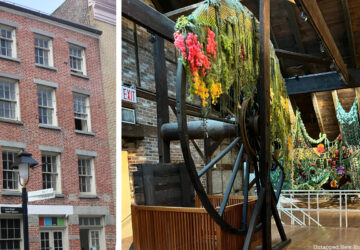
This area of the museum is one of our favorites because it retains much of the original structure and construction of Schermerhorn Row, where the museum sometimes curates exhibits within.

From the "Made in New York" exhibit in fall 2012

From the “Made in New York” exhibit in fall 2012

Next is Streetshots/NYC, in collaboration with the Museum of the City of New York, which shows hundreds of photographs taken of street scenes across the five boroughs in the years since 9/11. Taken by both professional photographers and amateurs equipped only with an iPhone, these images are by turn startling, hilarious, reaffirming, and workaday. The scant wall text, which includes only a year and photographer-provided title for each, leaves the viewer guessing and second-guessing at each image’s intention, location, subject, timing, and degree of serendipity. These are the scenes we see on the streets of our city every day, but often don’t stop for long enough to appreciate.

StreetshotsNYC is a collection of both professional- and amateur-produced photographs depicting various voyeuristic, often funny, street scenes from all five boroughs.

StreetshotsNYC is a collection of both professional- and amateur-produced photographs depicting various voyeuristic, often funny, street scenes from all five boroughs.

Through a hallway that once served as a hotel for traveling merchants, you’ll discover Romancing New York: Watercolors by Frederick Brosen, a show celebrating a New Yorker whose depictions of lower Manhattan and Coney Island architecture are almost photographic in detail. And around the corner is the brand new exhibition, A Fisherman’s Dream: Folk Art by Mario Sanchez, which uses painted wood carvings to visualize a maritime culture that is decidedly different from New York’s: the sleepy fishing villages of the early 20th-century Florida Keys.

Visitors can walk through the laundry room and the guest room hallways that were once part of a hotel at the site

Visitors can walk through the laundry room and the guest room hallways that were once part of a hotel at the site.

Last is Timescapes, the must-see multimedia presentation documenting New York City’s 400 plus-year history in a mere 22 minutes. Narrated by actor Stanley Tucci, the film uses an impressive collection of maps, photos, paintings, and historical accounts to weave a surprisingly inclusive tale that I guarantee contains surprises for even the savviest of New York City history buffs.

Fishing weights hang in the light-filled entrance to the 22-minute multimedia film Timescapes.

Fishing weights hang in the light-filled entrance to the 22-minute multimedia film Timescapes.

The video, along with the broad stroke approach the museum takes to confronting New York City subjects, makes the museum a sort of bite-sizeintroduction to the city for both newcomers and New Yorkers alike. This is convenient as the museum sits at the heart of a waterfront district that at one time saw nearly all of the country’s tradable goods and wide-eyed immigrants pass through its streets. Today’s seaport district has been tested by redevelopment and Mother Nature alike, but it is still an important draw for downtown visitors.

The Howard Hughes Corporation, owner of the long-declining Pier 17 shopping center, has big plans for its revival, which could help boost visitor numbers at the Seaport Museum, or at least give it cause for an exhibition on the changing nature of waterfront development in New York City. Or maybe the museum will curate a show on the threat of climate change, an issue it now has first-hand experience with. Whatever the case may be, the future of the South Street Seaport Museum, and its beloved namesake waterfront district, is in flux. So go see it now.

01/14/13 10:29am

Eleven weeks after  Hurricane Sandy, much of New York City has reassumed a state of normalcy, but as the headlines fade some victims are still taking their first halting steps toward recovery, settling in for the long road ahead. That’s the case in post-Sandy Staten Island. Neighborhoods like Cedar Grove, a close-knit beachside community of working-class families, took on 12 ft. of water as the superstorm raged against Staten Island’s south shore.

A damaged house in Cedar Grove, Staten Island.

Here, the shadow of the storm emerges in unexpected moments.  On a crowded bus, phrases like “You’re a hero” and “We were wiped out” are spoken without a shred of irony. On the sidewalk, conversation  fluctuates between anger and hope, laughter and tears.  Neighborhoods have been transformed, but not destroyed; living in the “forgotten borough,” Staten Islanders are known for their self-reliance. Still, organizers feel that the government has left them behind following last week’s decision to pass only a small portion of a Sandy relief bill.

This site visit was organized by the Municipal Art Society’s Charting the Road to Resilience conference, a program held Saturday, January 12th, to create a dialogue concerning the Sandy response in New York City.  Here’s a look at the ongoing recovery post-Sandy on Staten Island:

Melanie Cohn leads a walking tour through Cedar Grove.

Melanie Cohn of the Council for the Arts and Humanities for Staten Island leads a walking tour through Cedar Grove, Staten Island.

Cedar Grove Beach_New York_Untapped Cities_Will Ellis

Entrance to the devastated Cedar Grove Beach. A dozen houses once lined the ocean, now only two newer constructions remain.

Residents who've returned say that some of their neighbors haven't been back yet to survey the damage.   Many are still displaced in shelters, living in distant hotels, or staying four to a bedroom with in-laws.

Residents who’ve returned say that some of their neighbors haven’t been back yet to survey the damage.  Many are still displaced in shelters, living in distant hotels, or staying four to a bedroom with in-laws.

A lost portrait returned to a neighbor.

Some are living inside their damaged homes, struggling to make repairs themselves.  Countless individuals are dealing with the latent psychological effects of the storm.

Debris has been cleared from this lot, only a painted foundation remains.

Signs of progress are becoming more common. Debris has been cleared from this lot, exposing a painted foundation.

Devastation_New York_Untapped Cities_Will Ellis

Construction materials come and go as contractors begin the process of rebuilding. The city’s Rapid Repair service has been effective for many, although some residences are beyond help.

Collapsed House_New York_Untapped Cities_Will Ellis

A painted notice on this collapsed house warns looters to “keep out.”

American Flag

On Cedar Grove Ave, a damaged home becomes a symbol of resilience.

Spray painted markers and notices signify the livability of the houses, if residents have been accounted for, or whether or not the structure will be razed.

Snacks, Heat, and TV available at the grassroots recovery center at Miller's Field.

Across the street at Miller’s Field, a Brooklyn motorcycle club (the Hallowed Sons) has set up a recovery center.  Inside, victims, volunteers, and passersby can pick up a hot meal in a heated tent, watch TV, and enjoy some companionship.

Local restaurants donate  hot food to feed the neighborhood.

Local restaurants have been generous, donating hot food to feed the neighborhood.

A volunteer (and his dog) had been there since the day after the storm.

A volunteer (and his dog) had been camping out there since soon after the storm.  ”For every good story, there [are] bad ones,” he says.

FEMA stops by the recovery center.

A group of young FEMA staff check in with the center’s leader.

Sharing ideas with community leaders.

Last week, they were strangers, but today, a group of homeowners are coming together to organize a march down Cedar Grove Avenue in conjunction with similar demonstrations across New York and New Jersey.  Their unofficial motto? “It’s not a me thing, it’s a we thing.”

Organizers feel that the government has left them behind following last week’s decision to pass only a small portion of a Sandy relief bill.

Congress will vote on an additional $51 billion in aid later this week.

Congress will vote on an additional $51 billion in aid later this week.