

05/07/13 1:00pm

Sydenham House_Newark_New Jersey

This week in the Untapped Cities mailbag, an Untapped reader caught this flub by NBC News, which claims that the oldest private residence in the New York area is the 1712 Seydenham House. The Lent-Riker-Smith homestead was built almost 60 years earlier in 1665. The Lent-Riker-Smith homestead is the only remaining Riker house on the land given to Abraham Riker by Governor Peter Stuyvesant. The house is located discreetly behind a white picket fence between the entry to Riker’s Island and a Tudor garden apartment community in Queens.

For an in-depth look inside the Lent-Riker-Smith house and its current resident, Marion Duckworth Smith, check out Benjamin Waldman’s article on the Last Riker House.

riker-house-painting1

Have a burning question about cities? Want us to track down an obscure piece of history? Or just want to share something awesome about your city? Write to us at info@untappedcities.com or through our contact page

12/11/12 1:30pm

Untapped New York is a proud to be a partner of Let’s Go, with our shared vision for off-the-beaten path exploration in your own city and while traveling. To launch the collaboration, we curated a list of  our top “Untapped” places from our home base in New York City. These are all tried and true urban exploration sites that we’ve gone behind the scenes to cover on Untapped New York. How many have you been to? What others would you add to the list?

1.  The TWA Flight Center at John F. Kennedy Airport

Decommissioned in 2001 after the construction of the Jet Blue terminal, this cathedral to aviation by Eero Saarinen  fills you with the pride and optimism the aviation industry had in the 1960s. Preservation efforts have saved it from the wrecking ball and there are proposals to turn the TWA Flight Center into a hotel.

2. High Line Section 3

In the concrete jungle that is New York, it’s surprising to see nature in its chaotic, uncontrolled form. The celebrated High Line still has a section yet to be converted into a park  and you can sneak onto it if you know where to enter. Groundbreaking happened earlier this year on this sectio, which will become part of the Hudson Yards development, so see it soon.

3. Doyers Street Tunnel

On notorious Doyers Street in Chinatown, nicknamed “The Bloody Angle” because the curvilinear street enabled gangs to creep up on each other, you can still visit one of the tunnels which enabled some escapes. One entrance to the tunnel is in the middle of Doyers Street, near the the trendy bar Apotheke, and takes you out into Confucius Plaza on Bowery. The tunnel is populated by small businesses, ranging from medicinal shops, employment agencies, travel agencies, law firms and reflexology.

4. City Hall Subway Station

Once dubbed the “Crown Jewel” of the New York City subway station, this  is a station unlike any other in New York–filled with stained glass, Roman brick, tiled vaults, arches and brass chandeliers. Though not currently in use (the now standard longer trains could not platform properly on the curved track), the station sits only 600 feet south of the current Brooklyn Bridge station that houses the 4, 5 and 6 lines. You can see the station by riding on the 6 train after it ends at Brooklyn Bridge Park (if the lights happen to be on in the old station) or by taking a tour with the Transit Museum.

5. Superhero Supply Store

If you’re 8, 18, or 80, and and decide the next big step in your life trajectory is to become a superhero, the perfect one-stop shop for your success can be found tucked away in Park Slope. Brooklyn’s Superhero Supply company, an unassuming free-standing store that serves as the front for 826NYC, a not-for-profit writing lab for kids,  is often mistaken for a hardware store, but actually houses shelves of fun things like cans of Courage, Gumption, invisibility paint, and tools to help you scale walls. An easily missed trap door leads you into the writing lab.

6. 5Pointz

A familiar sight along the 7 subway line, 5Pointz Aerosol Art Center  is the largest legal aerosol art exhibit in the US and possibly the world.   It was first established in 1993 as a haven for aerosol artists to hone and showcase their craft.  There are approximately 350-400 pieces on the building at any given point. Its contributors, many of whom work under a different alias, come from all over the world to visit and work at the “graffiti mecca.” Check it out before it’s demolished next year.

7. The Secret Burger Joint in the Parker Meridien Hotel

This little faux-dive has a deserved cult following. Known as Burger Joint or Secret Burger among fans, it’s hidden inside the lobby of the Parker Meridien hotel, tucked behind thick floor to ceiling curtains with only a neon burger sign to denote what lies beyond.  Visually, the interior features vinyl booths, 1970s-era wood veneer paneling with sports and movie posters taped haphazardly, and no shortage of graffiti. It’s as if a mid-century burger joint was preserved and the hotel was built around it, but it actually opened only in 1999. Know your order or you’ll be sent to the back of the always long line.

8. Smallpox Hospital on Roosevelt Island

Between the new FDR Four Freedoms Park and Southpoint Park on the southern tip of Roosevelt Island sits the abandoned Smallpox Hospital designed by James Renwick. It’s landmarked as a ruin and FDR Four Freedoms Park hopes to stabilize it for us as a welcome center. Once only viewable from a distance along the East River (or for the intrepid urban explorer), the new parks enable the public to get up close and personal like never before.

9. Dead Horse Bay

Just near the Rockaways sits Dead Horse Beach, which not only contains the remnants of dead horses, but also a sea of vintage garbage from over a hundred years ago. The landscape is dotted with bottles, among which you can find perfume bottles from the early 1900s, creepy toys, plenty of household nicknacks, decaying boats and even (reportedly), old hand guns. The beach gets its name from the days it was was a horse-rendering plant, where dead horses were disposed with and you can still find horse bones in the flotsam.

10. Rikers Island

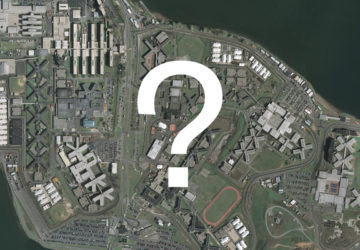
We spent six weeks inside the infamous Rikers Island prison teaching the Bill of Rights to incarcerated juveniles as part of the Rikers Island Project. Over the years, the MTA has both included and omitted Rikers Island from its maps, undecided as to how public or private the place truly is. But the Q100 MTA bus takes you across the bridge to the entrance of the Rikers facility, for those interested in setting foot on this island.

11. Staten Island Boat Graveyard

Perhaps you’ve heard of an elephant graveyard, but what about a boat graveyard? Does such a thing exist? Turns out it does, and New York City has one. Known as the Witte Marine Scrap Yard, the Arthur Kill Boat Yard, or simply the “Staten Island Boat Graveyard,” the city’s only remaining commercial marine salvage yard is located in Rossville, Staten Island, near  the Fresh Kills Landfill. It’s worth a visit, but be careful.

12. The Fake Brownstone in Brooklyn housing an MTA transit Facility

Don’t be fooled by the building exterior at 58 Joralemon Street in Brooklyn Heights. The middle brownstone is actually a ventilation facility for the MTA.

13. 46th Street Loew’s Theatre

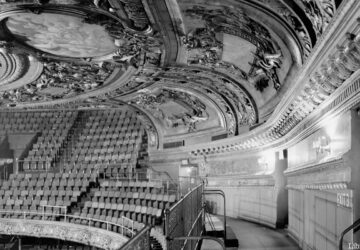
One of the many opulent theaters that once entertained New York’s finest, the Loew’s 46th Street theater was  the first atmospheric theater in New York City. It was designed to look like a night sky in an Italian garden.  Though in a state of architectural decay, it has not (yet) been demolished and serves as storage facility for a furniture company.

14. Vinegar Hill, Brooklyn

Nestled between symbols of urban industrialization and modern residential development, Vinegar Hill is a five-block square cobblestoned neighborhood next to the Manhattan Bridge that seems to have been preserved in time circa the nineteenth century. Catch a glimpse of the Commandant’s House in the Brooklyn Navy Yard and grab a bite to eat at appropriately vintage Vinegar Hill House.

15. The Campbell Apartment

We checked out the Campbell Apartment as part of our recap of the top 10 hidden bars of New York City. The bar  is situated in Grand Central Station, denoted by a small plaque in front of an unmarked elevator, and is a testament to the grandiosity of a different area. The space originally served as a private salon for 1920”²s financial mogul John W. Campbell and has been restored to give prominence to the intricately crafted woodwork on the ceiling, the stained glass windows, the dark wood paneled bar adjacent to the balcony and the large fireplace.

Get in touch with the author @untappedmich.  

08/24/12 10:51am

On a quintessential New York evening on the East River, timed with the landing of President Obama’s helicopters at the Downtown Manhattan Heliport, I joined openhousenewyork on their Other Islands Boat Tour. Led by Stuart Miller and Sharon Seitz, authors of the book The Other Islands of New York, the event aboard the packed yacht, the Zephyr, was a cocktail party blended with fun New York facts told by the dynamic hosts.

According to Miller, the islands reflect the story of the city as its priorities have shifted over time. Some were originally purposed as military protection from the British during the War of 1812, named later for the families that owned them, and transformed over time into places of leisure, of isolation, of residence, and often of heterotopia.

First up was the 1/2 acre man-man island U Thant Island, situated halfway between the United Nations building and Long Island City, named in honor of the former UN Secretary General from Burma. The island was created from the materials excavated by William Steinway in his attempt to built underwater tunnels in the East River between Manhattan and his company town in Astoria, Steinway Village.  Steinway died before completion of the tunnels, which were finished by August Belmont. Today the tunnels are still used by the 7 line train.

U Thant Island

Not mentioned was the little outcrop just south of Roosevelt Island, where occasionally “Lou” the seal mans his perch, observing the construction at FDR Four Freedoms Park.

As Roosevelt Island changed hands from Dutch to English to American, it subsequently underwent the necessary nomenclature changes””from Manning’s Island to Blackwell’s Island to Welfare Island. The latter name hints at the island’s functional role in New York City’s history””as a location for prisons, a lunatic asylum, and a smallpox hospital.

The new FDR Four Freedoms Park will open in October, must adjacent to the abandoned James Renwick designed Smallpox Hospital

The lighthouse at the northern tip of Roosevelt Island was also designed by James Renwick

Next was Mill Rock, originally two islands called Great Mill Rock and Little Mill Rock. The area was known as Hell’s Gate for the havoc it wreaked on ships, and the islands were connected in 1885 through a massive detonation by the Army Corps of Engineers that was felt all the way in Princeton, New Jersey.

Mill Rock

Randalls Island and Ward Island were also separate islands, connected via landfill by Robert Moses. As a child, I remember telling my father of the mysterious bridge which was sometimes elevated and sometimes not. It was just the 103rd Street Footbridge, which can be lifted in the center to allow ships to pass. Randalls Island is now home to Icahn Stadium and many sports venues.

Most curious to me were the abandoned North and South Brother Islands. Luckily, I was standing next to photographer Christopher Payne, author of Asylum: Inside the Closed World of State Mental Hospitals and New York’s Forgotten Substations: The Power Behind the Subway, and historic preservationist Randall Mason, who are jointly working on a book about North Brother Island. It was the site of the General Slocum steamship tragedy where over 1300 people perished, mostly immigrants. The island was also home to Typhoid Mary, where she was quarantined for the last two decades of her life.

According to Payne, there are no current plans for North Brother Island and it functions as a wildlife sanctuary.  The structures still remain, albeit in a state of decline, including a coal and boiler plant, and nurses quarters.

Southern view of North Brother ISland

Remnants of a dock at North Brother Island

The final island on the tour was Rikers Island. I’ve had the opportunity to enter the prison facility several times while working on a legal workshop for the incarcerated juveniles as part of the Rikers Island Project. It was one of the most incredible experiences I’ve had in New York City and I hope more readers will get involved.

Rikers Island

Don’t miss openhousenewyork weekend  this October, where you will gain access to many of the places you’ve previously read and seen on Untapped New York.

Get in touch with the author @untappedmich. Find out more about openhousenewyork.  

11/17/10 8:00pm

Over the past six weeks, I have been teaching the Bill of Rights to 16-18 year old incarcerated juveniles in the Rikers Island Prison as part of the Rikers Island Project, an advocacy and legal workshop run by Fordham Law School. Lil Wayne was in solitary when we first started, so unfortunately I wasn’t able to teach him his rights. However, we finished up  this past Sunday  on a high note with a mock trial. The level of involvement and excitement during the trial is a sign of how far we came in gaining their trust. At the conclusion of the workshop, the kids get a certificate of completion which can help reduce their time in Rikers.

Every Sunday, the volunteers leave bright and early from various locations throughout New York City to get to Rikers by 8am. One the first Sunday, I took the 2 train to Atlantic Avenue, Brooklyn at 6:15am to catch a ride with fellow volunteer, James, at 7:00am. There has been high turnover at the Department of Corrections (New York’s Boldest), so getting clearance for ourselves and personal cars has been quite a battle. On the first week, James’ car wasn’t cleared in time, so we left the car in visitor parking before the Rikers Island Bridge and hopped on the Q100 MTA bus to get to the entrance of the prison

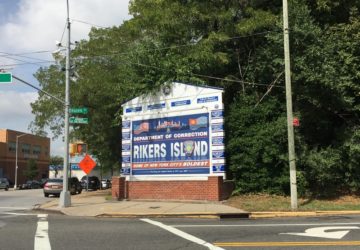
Welcome to Rikers, the sign before the bridge:

The super intense sign in the parking lot. I risked prosecution and kept my cell phone so I could take pictures up until the very last minute:

With car clearance, you can drive over yourself, but you have to first park the car, walk to a trailer in the parking lot to have your registration and IDs checked for everyone in the car. The Rikers Island cat hangs out here and has its own little “prison” -like crate which it lives out of.   Sometimes the office gets confused which paperwork is for the current week, so clearance can take some time. Afterwards, we get back in the car, pass the security booth where we show all of our IDs again, along with a newly-acquired vehicle pass.

More threatening ALL-CAPS messages about arrest and prosecution at the bus stop:

The bus with Rikers visitors was extremely crowded for 7:30am on a Sunday:

The fantastic view of the Manhattan skyline and industrial Queens from the bridge:

On the other side of the bridge, there are two main buildings–one with an ID checkpoint and security line and another sparsely-entered one. After going through the ID checkpoint and X-ray scan, James & I discovered that nobody knew where we were supposed to be. We were forwarded from supervisor to supervisor until someone realized we were supposed to be in the building next door. To this day, I am not 100% clear on the difference between the two entrances, but it seems related to whether you are coming in as a “regular visit”  or an institutional visit, of which we were the latter. At any rate, here we show our IDs again and are given a plastic badge with a number on it and a invisible hand stamp (shows up only with UV light). We then cross a big parking lot to get to the RNDC (Robert   N. Davoren Center). On the last day we were instructed to cross this parking lot in groups of three, “so we wouldn’t get stopped.”  This seemed strange, but we don’t generally question correction officers, on principle. Rikers is massive, and even the officers comment on how “far” the RNDC is from the entrance.

Regular visitor entrance, before the X-ray scan:

Even though we arrive at the same time every Sunday, the RNDC entrance has never been manned by the same officer. As a result, there is a lot of confusion every week as to who we are and what we are doing. We get our IDs checked again, sometimes verified against a list of names they have, sometimes not. We handwrite our names into a log book, along with the number on the plastic badge. We put our sparse belongings through an X-ray and pass the metal detector. In this next room, we have to show our IDs again and exchange our plastic badges for a yellow laminated badge. We get led to another security station where we have to show the yellow badges.

At this point, the architecture abruptly changes. Before this, you could have convinced yourself it was a school–the light blue paint, the photos on the wall, the offices. Here, a long hallway stretches seemingly indefinitely with retractable prison bar walls, sanitary beige paint, and defunct x-ray machines. Natural light floods this corridor, but the view outside is of barbed wire. About halfway down this corridor is an incredible mural, but we walk by it so quickly every time that I was mostly struck by the expressionist style of the brushstroke and the contrast it makes with the linearity of the hallway. But I remember there being women in the mural, the one thing that this prison clearly lacks (except for the female correction officers).

After the mural, the architecture shifts again as we descend a staircase into a freezing extension built of plywood walls. This opens onto a narrow concrete walkway with high fences and barbed wire. It’s this moment that conjures up images from the Shawshank Redemption and Le Prophet, because you get a clear message about your own inconsequentiality and the futility of escape. Across another large asphalt area is the building where the juveniles stay. We call it the greenhouse, which may have been a term picked up from the corrections officers. I think it’s an apt term, because it consists of two cavernous but well-lit rooms. Think of inflatable indoor tennis structures but filled with beds, neatly lined in rows. It’s nice to know that these kids are not being housed in jail cells. Even though they may be tried as adults, the system differentiates their age in terms of treatment.

Usually when we arrive, half of the kids are still asleep. Alexi, one of the team leaders from Fordham, rounds them up out of bed. Having worked for Teach for America, she is fearless and they listen to her. There is a semi-circular area at each end of the sleeping hall, used for activities and “welcoming”  new inmates. We hold our workshops here. The acoustics of the activity room make it impossible to hear anything unless you are sitting close to each other. This facilitates discussion but there is usually a group of kids that refuse to participate and create noise in the background. The range of personalities is pretty close to what you would find in any classroom–there are the outgoing ones who get into the discussion, the reserved ones who prefer to observe, the withdrawn ones that sit at the outskirts, and the troublemakers in the back of the room. Some seem to eagerly anticipate the class, asking what we are going over that day and looking through the law textbook they got from the prison library. But sometimes the noise gets too much for the less outgoing and they begin to feel isolated when they can’t be heard.

By the time of the mock trial, I noticed that the group of non-participators had shrunk. We handed each person a fact-sheet of the trial and asked them to pick a side: defense or prosecution. I’m not that experienced in law, but I do know how to direct people around and get them excited about things–so I had them gather around and pick roles. We ended up having an overwhelming number supporting the defendant and wanting to be his lawyer. We had a massive legal team of four lawyers (at one point six lawyers were involved) and others playing the defendant or various witnesses. We then coached each person on the facts of the case and to work through what questions they were going to ask or what they would answer on the stand.

The caliber of many of the “lawyers”  was truly impressive. Some were methodical, some were dramatic, but they all seemed to relish the opportunity to act. Many “objections”  were called, “evidence”  was submitted to the judge, and we often had to quiet the legal teams down. At the end, the debate was so heated that each side tried to enter the jury circle, to which we had to call tampering of the jury. The defendant lost his case in a close 6-5 decision, but I reassured everyone that the defense would “appeal.”

I thought that everyone did a great job and made sure to reinforce my sentiments whenever any kid finished questioning or answering. One was so disappointed in his performance that he continued to ask me if he had done a bad job after the case was over. For me, the most rewarding moments came from a few specific kids (names abbreviated for privacy reasons). I met both Y and H on my first day. Both were active in the discussion and we talked about our neighborhoods and family backgrounds–a reaffirmation that despite our different circumstances, there is still much that is shared. Y told me he anticipated to be released soon, but on the last day he was still there. He seemed less involved this time and I was concerned, until he told me that his case had been dismissed and he was going home the next day. I wondered if he was worried about his future outside of Rikers but I did not get a chance to have a more in-depth conversation. We had previously discussed his hopes and goals for the future and I hope he will get a chance to pursue them. On the last day, H asked me if I would visit him between Christmas and New Years, and also chastised me for not showing up the week before (there was a slashing, so the prison was on lockdown). I told him I would try my best and I got his full name, so I plan on bringing him a Christmas gift. A fellow volunteer told me that H’s family doesn’t visit him so hopefully I can make his time in Rikers over the holiday a little less lonely. And finally, perhaps the most touching moment came from one of the quieter kids. He came up to me holding the fact sheet at the end and timidly asked, “Is this the last session?”  and asked if he was could keep the fact-sheet. He seemed genuinely disappointed it was over, and I do hope for him and the others that we opened up a new avenue of possibility for their future, even if our impact was limited.

There are prisons in every borough, check out ones you might not even have noticed!

Get in touch with the author @untappedmich.

10/06/10 7:29pm

One of the most popular Untapped New York  articles has been about the prisons of New York City. This fall, Untapped will be partnering with Livingthedream.org and Fordham Law School to run a 6-week advocacy and legal workshop for some of Rikers Island’s incarcerated juveniles.  The program started in summer 2009 and will commence again mid-October. As Janos Marton, Fordham Law graduate and  Livingthedream.org founder writes, “Rikers Island is, for many youths, their introduction to the criminal justice system, and the awful experience that follows profoundly impacts their young adulthood.  While some kids never opened up to us, others loved our program, which involved group discussions about legal issues ranging from gun control (in light of the Plaxico Burress shooting) to cannibalism at sea, to a fantastic mock trial the last week of the program. Some of these kids were sharp, savvy and charismatic, full of potential but for the path they had gone down. Many peppered me with questions about college, law school and making money during and after each workshop. One even explained to me how to fake collapsing in fear in order to pull a gun and shoot someone in self-defense. Let’s put it this way: there was never a dull moment.”  The program has the full support of the Rikers Island staff, especially in the face of recent budget cuts.

This fall’s workshop will cover each citizen’s Constitutional Rights,  focusing on the 1st, 4th, 5th and 6th amendments of the Bill of Rights. We are even thinking of bringing in musical instruments for some of the sessions. Most importantly, Untapped and  Livingthedream.org are looking for volunteers (legal background not necessary).  While continuity is the best way to build up a relationship with these kids, even committing to two Sundays can be helpful.   Fluent Spanish speakers would be helpful to deal those that speak little English and often feel left out of our discussions. The sessions will run between 9:30 and 11:30am. If interested, please e-mail michelle@untappedcities.com.

* Update: A recap on this year’s workshop!

For a more comprehensive look at last year’s Rikers Island workshop, check out Janos’ writeup on Livingthedream.org.

10/06/10 7:29pm

One of the most popular Untapped New York articles has been about the prisons of New York City. This fall, Untapped will be partnering with Livingthedream.org and Fordham Law School to run a 6-week advocacy and legal workshop for some of Rikers Island’s incarcerated juveniles.  The program started in summer 2009 and will commence again mid-October. As Janos Marton, Fordham Law graduate and  Livingthedream.org founder writes, “Rikers Island is, for many youths, their introduction to the criminal justice system, and the awful experience that follows profoundly impacts their young adulthood.  While some kids never opened up to us, others loved our program, which involved group discussions about legal issues ranging from gun control (in light of the Plaxico Burress shooting) to cannibalism at sea, to a fantastic mock trial the last week of the program. Some of these kids were sharp, savvy and charismatic, full of potential but for the path they had gone down. Many peppered me with questions about college, law school and making money during and after each workshop. One even explained to me how to fake collapsing in fear in order to pull a gun and shoot someone in self-defense. Let’s put it this way: there was never a dull moment.”  The program has the full support of the Rikers Island staff, especially in the face of recent budget cuts.

This fall’s workshop will cover each citizen’s Constitutional Rights,  focusing on the 1st, 4th, 5th and 6th amendments of the Bill of Rights. We are even thinking of bringing in musical instruments for some of the sessions. Most importantly, Untapped and  Livingthedream.org are looking for volunteers (legal background not necessary).  While continuity is the best way to build up a relationship with these kids, even committing to two Sundays can be helpful.   Fluent Spanish speakers would be helpful to deal those that speak little English and often feel left out of our discussions. The sessions will run between 9:30 and 11:30am. If interested, please e-mail michelle@untappedcities.com.

* Update: A recap on this year’s workshop!

For a more comprehensive look at last year’s Rikers Island workshop, check out Janos’ writeup on Livingthedream.org.