

01/17/13 9:06am

When my sister was younger, she used to say that her favorite color was orange because “nobody else likes it.” Sometimes I think I feel the same way about subway trains, like the C Train. Last time we “Untapped” the G train: the butt of many jokes and the arguable victim of a certain amount of inconvenience (sprinting along the platform) and neglect (few trains, few transfers).

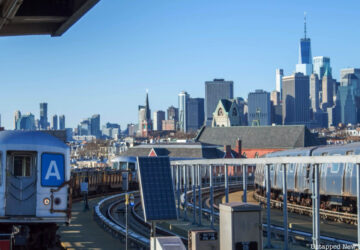
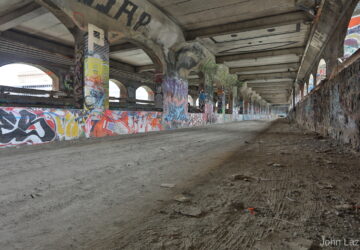
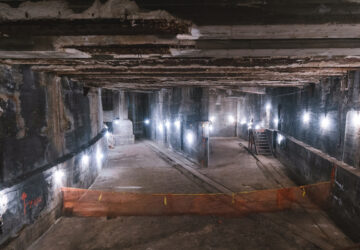
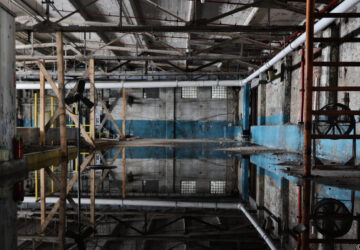
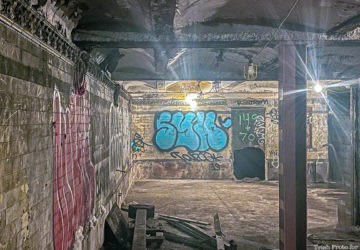
Over the summer, the Straphangers Campaign released its annual report of subway trains, ranking them on criteria such as “cleanliness,” “service regularity,” and “breakdown rate.” For the fourth year in a row, the C train was voted the “worst.” Of course, now I’m intrigued. I set out to find out what could be hiding in plain sight above the C train, from when it breaks off from the tangle of trains at Clinton-Washington Aves station, to when it rejoins other lines again at Broadway Junction.

My route, trying to follow aboveground as closely as possible the train’s route.

My route, trying to follow aboveground as closely as possible the C train’s route.

(more…)

01/07/13 3:22pm
Dr Zizmor Parody Subway Ad Dr Armond Comedy Central-001

Dr. Zizmor Parody Ad

Untapped Cities writer Benjamin Waldman snapped these photos of a parody Dr. Zizmor ad in the New York subway today on the E train. A quick check of the website puppylift.com  reveals the source: Dr. Armond aka Nick Kroll on Comedy Central! The famous, long-running ad is recreated–font, colors and layout. But in the tag line is “Is your dog a total dog?” and in  place of Dr. Zizmor is Dr. Armond with a golden retriever licking his face. The before and after photos show a bull dog transformed into a Jack Russell terrier. In place of the success quote from Dr. Zizmor is Armond’s supposed quote:

“You wouldn’t buy an ugly sofa; you wouldn’t talk to an ugly person. I only hire very attractive people and my third wife is one of the  most beautiful women I know.”

Dr Zizmor Parody Subway Ad Drmond Comedy Central-002 Puppy LIft Ad

Puppy Lift

Dr Zizmor Parody Subway Ad Drmond Comedy Central     Here are some original Dr. Zizmor ads to refresh your memory:

Dr Zizmor Subway Ad New York City

Dr Zizmor Beautiful Clear Skin (Source: Transportation Nation)

Dr Zizmor Tight Skin Without Surgery

Dr. Zizmor “Tighten Skin without Surgery” ad (Source: Village Voice)

Have you seen this Dr. Zizmor parody ad? Or other parody ads? Let us know! Get in touch with the author @untappedmich.

12/14/12 4:28pm

For the past few weeks I’ve felt very exposed on the subway. As a member of the nascent New York Public TransLit Commuter Book Club, I dutifully read the selected volume on the subway, as a sort of signal of participation to anyone else in the club. No takers. It didn’t help my paranoia that the further I got into Andy Greenberg’s excellent This Machine Kills Secrets: How WikiLeakers, Cypherpunks, and Hacktivists Aim to Free the World’s Information, the more aware I was of issues of privacy, information leaking, and anonymity.

Togather, the event’s organizer, is a sort of online meeting place for authors and readers, and serves as a way to populate and enliven literary events such as book tours. Anjelica Triola, Senior Marketing and Communications Manager at Togather, explained to me how with a field of over 300 authors, Togather is especially interested in introducing writers to their local audiences, and thus readers to the author that may be living down the street. The Public TransLit Book Club was inspired by a Seattle bus-riding version, with the added twist of bringing the readers and authors together for discussion.

On Wednesday, around 30 book-toting members pushed our way through a very lively networking event of the Young Education Professionals, down the stairs into the appropriately dim basement of Lolita Bar on the Lower East Side to hear from Greenberg.

Andy Greenberg discussing “This Machine Kills Secrets” at Lolita Bar.

Greenberg, who writes for Forbes and acknowledged the humor in covering “hackers for a billionaires’ magazine,” has spent years investigating the world of WikiLeaks and cryptography, delving ever deeper into the accompanying technical, ethical, and political implications. This Machine Kills Secrets begins with the story of Daniel Ellsberg and the Pentagon papers, while tracing the convergences and divergences of that story with the one of Bradley Manning. The book then takes us back to the dawn of the internet, and shows how the impulse for anonymity, and the opposing one to expose it, have been present since then in the form of groups like the Cypherpunks, before moving back to WikiLeaks and the current state of anonymity efforts.

Greenberg, with a WikiLeaks server under his arm, and the book. Images courtesy the author.

There are book reviews available of This Machine Kills Secrets; I barely understand some of the more technical concepts myself, and am hardly qualified to even mention Mix Networks or the differences between PGP and Tor identity-encryption. But I can give you an idea of how fascinating the talk was: about one-third of the way through, a drunk YEP attendee started down the stairs, got a glimpse of all of us, then ran back up and loudly complained, presumably to whomever had sent him down the stairs, “They’re all sitting down there mesmerized by some speaker!” We were.

Andy Greenberg signing copies of “This Machine Kills Secrets.”

The $30.40 I paid for the Public Translit Book Club bought me the book in hardcover, two drinks at Lolita, and a face-to-face with the author and other interested New Yorkers. In other words, it felt like a steal. And although no one approached me on the subway, it was exciting to imagine that there were other commuters out their holding up their book spines with anticipation instead of hiding the torrid love scenes of 50 Shades of Grey on their Kindle. I’ll be attending the next New York Public TransLit Commuter Book Club, and, hey, maybe you’ll know me by my subway reading.

Connect with the author at @kaygegay

11/20/12 9:10am


Riding the subway is an experience of alternately judging people and ignoring them by playing phone games. Looking at Walker Evans’ subway portraits, not much has changed. It is somehow reassuring to know that even in the 1930s, New Yorkers were still annoyed by the general presence of pretty much everyone else. What is different, however, is the general proliferation of fur. And hats. Lots of hats.

After documenting depression-era rural America in the book Let Us Now Praise Famous Men, Walker Evans turned his attention to city life and New York was the obvious choice.   Over a period of three years, between 1938- 1941, Evans took photographs of fellow subway riders with a camera hidden in his coat. Despite the surreptitious hiding place, many of the subjects seem to stare directly into the lens as if they are totally aware that they are becoming subject matter (which says something about the intensity of a subway stare).

For a more refined interpretation of Walker Evans photographs, I turn to James Agee, who wrote the introduction to Evans’ book on the images, Many Are Called. He writes,

Those who use the New York subways are several millions…They are members of every race and nation of the earth. They are of all ages, of all temperaments, of all classes, of almost every imaginable occupation. Each is incorporate in such an intense and various concentration of human beings as the world has never known before. Each, also, is an individual existence, as matchless as a thumbprint or a snowflake. Each wears garments which of themselves are exquisitely subtle uniforms and badges of their being. Each carries in the postures of his body, in his hands, in his face, in the eyes, the signatures of a time and a place in the world upon a creature for whom the name immortal soul is one mild and vulgar metaphor.

I’ve seen many people on the subway to whom I might apply the term “vulgar metaphor”, and I laude Agee for finally giving me a vocabulary to do so. But like it or not, we somehow put up with each other- even if it is only in the name of going from Point A to Point B.

For more photos and commentary, visit Neon Mamacita.

11/08/12 9:23am

Not everyone checks the transportation conversation on Twitter as obsessively as I do, but even a casual visitor over the past week would notice that the G train was on the mind of transit-interested New Yorkers, and probably most of the people living in North Brooklyn. While the G was down from Hurricane Sandy, the MTA refused to give predictions of when the IND Crosstown service would be back online, with conspiracy theorists claiming that reconstruction on the G would simply be delayed until we stop asking about it and the service becomes defunct.

I wouldn’t count on that happening. I know it’s a low-density line, and I understand that connecting Brooklyn and Manhattan was a main concern for the MTA (as a Windsor Terrace resident, I can attest that getting out of the borough was a nightmare for days). But as a typical “new” Brooklynite, I can also attest that the G is absolutely vital to my interests. It connects the hipster backbone of Long Island City, Williamsburg, and Park Slope. It cuts the commute time to Western Queens in half. It is the only subway winding its way through the heart of Bed-Stuy.

The MTA will not simply leave the IND Crosstown to rust, but as the only non-shuttle that doesn’t enter Manhattan I think the poor G often gets short shrift. So, while it was down for the count, I decided to appreciate the G, to “untap” it and show you the gems just above ground along the line.

My route, trying to follow aboveground as closely as possible the train’s route

GoogleMaps told me that my journey from the first G-only stop, Fulton St., to the northernmost Brooklyn station, Greenpoint, would be 4.4 miles and take 1 hour and 27 minutes. Since I’ve found that GoogleMaps usually thinks my walking speed is a brisk jog, I planned for a longer trip. [Final time: 2 hours and 37 minutes]

Fulton St Station

Bible verses on the wall of 69 Lafayette Ave

Gourds talking to each other at 92 Lafayette Ave

Stairwell mural at 126 Lafayette Ave

“still moving” at 136 Lafayette Ave

Masonic temple at Clermont Ave and Lafayette Ave, next door to Queen of All Saints church

White rollerblades with flowers (a memorial?) tied to the stoplight at Lafayette Ave and Washington Ave

MTA workers surfacing the steps at Clinton-Washington Avenues Station

Bike parking at Pratt Institute’s Higgins Hall, Lafayette Ave and St. James Pl

312 Lafayette Ave under construction

Classon Ave station

No Parking, with friendly enforcers

Climb up to the bench at 444 Lafayette Ave

Ornamentation at 474 Lafayette Ave

Bedford-Nostrand Avenues station

Poison and dogs at 551-553 Lafayette Ave

A splash of blue at 577 Lafayette Ave

Chicken coop at 535 Lafayette Ave

GreenThumb park on Lafayette Ave and Marcy Ave

Stay Cool at the Kosciuszko pool on Marcy Ave and Kosciuszko St

Kingdom Hall of Jehovah’s Witnesses on 685 Dekalb Ave

Bed-Stuy cats at 650 Marcy Ave

“U Like Chinese Food” at Willoughby Ave and Marcy Ave

Memorial for Mack at 599 Marcy Ave

“Flat Fix God Love You” at 580 Marcy Ave

Myrtle-Willoughby Avenues station

The grates were my G-train yellow brick road, although they weren’t usually this aesthetic

Pfizer plant at Flushing Ave and Union Ave (Marcy Ave turns into Union)

Flushing Ave station

Empty lot at Union Ave and Wallabout St

Acme Power Transmission, which inexplicably uses stuffed animals in its display, at 578 Broadway

Broad & Boerum, a Hasidic building in the former Lincoln Savings Bank

Broadway station

A modern obelisk? At 190 Union Ave

Metal copse at 251 Union Ave

Backed-up gas lines at S. 2nd St

Mural at Union Ave and Grand St

I liked the clover awning at 418 Union Ave

Metropolitan Ave station and the infamous Kellogg’s Diner

The former location of Our Lady of Mt. Caramel at Jackson St and Union Ave under the BQE

Architectural waves at 610 Union Ave

Uprooted tree from Hurricane Sandy in McCarren Park

Bradley Manning mural at 55 Nassau Ave

Nassau Ave station next to Yelena’s Shoe Repair, which I can corroborate is a good shoe place

A surprising wooden door at 671 Manhattan Ave

Greenpoint Savings Bank, now inhabited by Chase

A new CVS going in at Manhattan Ave and Milton St

Greenpoint station

On Wednesday morning, G train service was brought back online, albeit slowly, and I’m more thankful for it than ever. At least now, as I wend my way northward, I’ll be able to imagine the route overhead.

Follow the author at @kaygegay

10/24/12 12:30pm

“Rush hour” on Hawthorne Bridge as Portlanders cross on their everday way to work, school, and play

Entering into the mouth of the Hawthorne Bridge, travelers will find a herd of bicyclists young and old, from businessmen to clad hipsters, from the first-timers to the avid riders, all heading into Downtown Portland.

Portland is a bike-friendly city with bike paths, lanes, and boulevards for bicyclists

Bike paths and bike lanes are scattered throughout the city like arteries all connecting to the heart of Portland,   with a total of 180 miles of bike lanes and 79 miles of off-street bike paths. The city has also built 30 miles of Bike Boulevards also known as neighborhood greenways reserved for bicyclists to safely ride freely throughout its city limits.

Bike lanes are stamped all around the city limits of Portland

Portland has been dubbed a Bicycling Mecca for its vibrant bike culture

Over the years the city of Portland has become a popularly known bicycling mecca in the US for its growing bicycle network and a world-class bicycling infrastructure. This has been partly accredited to the work done by the Bicycle Transportation Alliance (BTA), a non-profit organization which for the past twenty plus years has worked in serving the Portland metro area on a mission “to promote bicycling and improve bicycling conditions in Oregon.” 

The offices of the Bicycle Transportation Alliance

2008 was a big year for the Rose City. After campaigning for years for the city to go Platinum, The League of American Bicyclists awarded Portland as the first major US city the title of Platinum-level Bicycle Friendly Community. Portland has rightly earned this status because “Anyone who wants to ride can ride,”  said BTA Communication Director, Margaux Mennesson. Portland was the first US city to implement bike boxes at intersections and elementary-school bike commuting trains.

The BTA has been a leading bike advocacy non-profit organization in Portland and in the state of Oregon for the past twenty years

Portland offers bicyclists many places to ride

Portlanders can ride safely around the city sharing the road with drivers

A cyclist’s paradise

Fast-forward to 2012. Portland reclaimed the first spot on Bicycling magazine‘s list of  America’s Top 50 Bike-Friendly Cities, before Minneapolis in 2nd and Boulder, CO in 3d place. The BTA is currently in the works of publishing the Blue Print for Better Biking, “a guide for building a world-class network with the highest standards for our region.”  Between the summers of 2012 through the spring of 2013, the BTA will engage policy experts, cycling advocates, and the public in order to make this happen. Portlanders meanwhile continue to ride, and a new bike shop in the city is probably the first to offer bike valet parking.

Get in touch with the author @alicperez.